Showing posts with label curriculum. Show all posts

Wednesday, December 19, 2018

The Prepared Environment

“To assist a child we must provide him with an environment which will enable him to develop freely.” – Maria Montessori

One of the most unique aspects of a Montessori learning environment which sets it completely apart from other classrooms is the preparation and sequencing of the materials which Maria Montessori created over a century ago with the children whom she guided. Since her death in 1952, Montessori guides (teachers) have continued using Montessori materials and creating materials inspired by her scientific approach. In her books, Montessori speaks so often about the importance of the prepared environment where child can cultivate confidence, independence, and mastery.


“The environment itself will teach the child, if every error he makes is manifest to him, without the intervention of a parent or teacher, who should remain a quiet observer of all that happens.” – Maria Montessori

Usually, shelves in the Lower Elementary room are arranged by curricular area – Language, Math, Practical Life, and Cultural studies. Guides rotate the shelves throughout a school year, due in large part to the observations of the children by the adult guide. She notices which materials are relevant and enticing to the children, and she also observes when the children are no longer intrigued. When new materials appear, interest is stirred and activity is contagious amongst the children, who want to manipulate the concrete materials with their hands and other senses.

“The environment must be a living one, directed by a higher intelligence, arranged by an adult who is prepared for his mission.” – Maria Montessori


The center of the 6-9 year old mixed-age classroom is Cosmic Education, the scope and order of the stories of the Universe from largest and oldest to the most recent and familiar. The vastness of the Cosmic curriculum in particular – from astronomy, physics, and chemistry to geology, geography, and life sciences – demands fluidity of movement as the children move through the Great Lessons. The children’s best and first teacher is the real material which they are given to touch, such as real plants in need of water, real fossils of trilobites, and real igneous rock that was once ejected from a real volcano.

“The child must live in an environment of beauty.” – Maria Montessori


Regular change on the Cultural shelves mimics the inevitable and continuous changes on Earth – from the growth of continental plates from vulcanism to the erosion of rock through the Work of Wind and the Work of Water to the migration of humans due to natural hazards and civilization. These grand ideas are presented as key experiences to spark the imagination of the child.

“To do well, it is necessary to aim at giving the elementary age child an idea of all fields of study, not in precise detail, but an impression. The idea is to sow the seeds of knowledge at this age, when a sort of sensitive period for the imagination exists.” – Maria Montessori

Math shelves contain materials which the child can use independently or with a partner after an initial lesson from an adult Montessori guide. The materials are also sequential and attuned to different learning styles. For example, several different materials can be used by a child learning a math operation, such as addition. The Golden Beads are all the same color and require the child to use her pincer grip, which is developing at the 6-9 ages, with great care and precision. The Stamp Game is similar to the Golden Beads in terms of quantity and place value concepts, yet variations include size, shape, and color (also reinforcing place value – green representing units, blue representing tens, and red representing hundreds).

“The first aim of the prepared environment is, as far as it is possible, to render the growing child independent of the adult.” – Maria Montessori


The Small and Large Bead Frames are often an option preferred by children with strong spatial and kinesthetic learning styles, especially those who have tired of using the Stamp Game in a plane; the Bead Frames allow exchanging to happen in the vertical sphere. The Bank Game allows children to work together in small groups, role-playing using the expanded form of the operations. In most Montessori classes, the children eventually (and ideally) work with such confidence and independence that they hardly register the observing presence of their adult guide.

“The teacher’s first duty is to watch over the environment, and this takes precedence over all the rest.  Its influence is indirect, but unless it is well done there will be no effective and permanent results of any kind; physical, intellectual or spiritual.” – Maria Montessori

Language shelves contain materials (usually card materials) which are self-correcting and self-explanatory for a child to use – again, after an initial lesson with an adult Montessori guide, by herself or with a partner. Children learn sounds of vowels and consonants using Phonics towers, language relationships (such as compound words, synonyms, and homophones) using Word Study drawers, and parts of speech (such as nouns, adjectives, and prepositions) using Grammar boxes.

“Not upon the ability of the teacher does education rest, but upon the didactic system.  When the control and correction of errors is yielded to the materials, there remains for the teacher nothing but to observe.” – Maria Montessori


Children keep track of the drawers they complete in order to find appropriate partners of any age, and many children enjoy the maturity and responsibility of giving lessons to their peers. The adult guide watches and intervenes only when needed, redirecting the child back to the material and using questions to assist in the child’s own discovery. Children help each other in the same way as the adult models them, avoiding telling an answer and instead asking questions or walking through the prepared environment to locate resources such as a dictionary, atlas, or thesaurus.

“Education is a natural process carried out by the human individual, and is acquired not by listening to words, but by experiences in the environment.” – Maria Montessori

Practical Life is an area of the Montessori curriculum which is central to the 3-6 year-old Primary classroom, however since Lower Elementary children ages 6-9 are also still developing fine motor, gross motor, sensory integration, and self-regulation skills, the activities and materials on the Practical Life shelves provide great relief and reprieve for children from the abundant (and sometimes rigorous) academic materials.

“The exercises of practical life are formative activities, a work of adaptation to the environment. Such adaptation to the environment and efficient functioning therein is the very essence of a useful education.” – Maria Montessori


Practical Life materials are hands-on – such as braiding, sorting, and weaving. Practical Life materials are creative – such as watercolors, clay tablets, and building blocks. Practical Life materials soothe and calm the whole body – such as yoga, jumping rope, and carrying hand weights. These shelves are favorites for children in need of a “brain break” who often return to their intellectual work soon after with renewed energy and concentration.

“The materials, in fact, do not offer to the child the content of the mind, but the order for that content.” – Maria Montessori

One of the most iconic places in any Montessori learning environment is the Peace Table, a beautiful space where children may sit by themselves or with a friend with whom they have conflict. In a Primary room, a single rose in a vase on a table symbolizes Peace. In my Lower Elementary classroom, I have decorated our Peace Table (which sits close to the floor) with a soft scarf, a Tibetan singing bowl, a Chinese meditation egg, and a few lovely gemstones. Maria Montessori respected children as emotional, intellectual, social beings. The adult guide may give a lesson on how to use the Peace Table – either for internal balance or for interpersonal problem-solving – yet it remains in the child’s power to decide if and when to use the materials.


“The children must be free to choose their own occupations, just as they must never be interrupted in their spontaneous activity.” – Maria Montessori

The scope and sequence of the Montessori curriculum and classroom set-up is quite intentional, not unlike the scaffolding of a building under construction – or a theater stage. Children are unaware of the preparation of their learning environment – from lessons to materials to shelf layout and rotation. They do not need to know all the content or all the steps in order to grow. They only need to feel secure that they are free to explore and discover in an organized fashion.

“Freedom without organization is useless.  The organization of the work, therefore, is the cornerstone of this new structure.  But even that organization would be in vain without the liberty to make use of it.” – Maria Montessori

Saturday, April 15, 2017

Montessori's Second Great Lesson: The Coming of the Earth


After the introduction of Montessori’s First Great Lesson: The Coming of the Universe, lower elementary children are eager to explore The Second Great Lesson: The Coming of the Earth. This study of the Earth begins, as the Universe study began, with cultural origin stories from around the world, as well as the evolving story of the scientists which involves facts, evidence, and the Scientific Method. It incorporates physics, chemistry, geology, and physical geography. Children learn about the conditions which existed that allowed land to solidify and water to form in the first place.


As in the Montessori 3-6 classroom, land and water forms are introduced in the 6-9 environment with greater detail and sophistication, and with different materials. In the 3-6 environment, children often pour water into shaped land forms to demonstrate land and water forms as opposites. For example, an island – which is land surrounded by water – is the opposite of a lake – which is water surrounded by land. This holds for the many other land and water forms studied in greater depth at the 6-9 level, such as isthmus and strait, cape and peninsula, etc.


Children are introduced to plate tectonics and discover how land forms (which we call continents) have been changing and moving on top of the crust of this planet for billions of years. This study helps us to discuss the eternal situation on this planet of climate change, which is affecting us as humans with great importance. Over the years, I have used various food items to demonstrate the three kinds of plate boundaries – transforming, convergent, and divergent. (This nomenclature also connects to terminology used in geometry lessons for some of the children, further deepening their neural pathways.) Whether I’ve used molasses, marshmallow fluff, or maple syrup with graham crackers, the learning environment smells sweet for several days. Children enjoy the texture of real materials as symbols of giant planetary processes.


The study of geology continues with the factors that allowed for plate tectonic activity – volcanoes and earthquakes. At the 6-9 level, children enjoy making their own exploding volcanoes (using baking soda, vinegar, and food coloring) and research famous eruptions to see how these natural disasters later affected animal and plant lives.


Long before the first life forms existed, rocks did, and children learn about the three main kinds: sedimentary, igneous, and metamorphic. Real examples of these rocks sit on our geology shelves waiting to be touched and understood. This photo shows an extension that involves creating a sedimentation jar, revealing the layers that these rocks make underneath our feet!


As with land and water forms, the continent puzzle map cabinet is introduced in Montessori 3-6 classrooms and used with more depth and detail at the 6-9 level. Children make their own maps of the continents, which provides both a direct aim (identifying land forms and water forms by name and shape) and many indirect aims: refining fine motor skill, connecting the child with places of relative distance, and conceptualizing the spiritual aspect of self in relation to land and water forms of such sizes and at such distances from one another.


The main purpose of the continent puzzle maps is not that a child will memorize all of the names and locations of countries in Asia, but that s/he begins to grasp his/her smallness within the infinite Universe, in terms of space, size, and time. Children often share the labor of this work with a friend and ask the other to hand him/her a certain country so that it may be traced, then labeled, then colored, then brought home to wallpaper one’s bedroom.


Finally, children continue learning about the Work of Wind and the Work of Water by studying the atmosphere, erosion, and weather. A fun way to explore these topics is to learn how to discriminate visually between different kinds of clouds, their shapes, and their meanings when seen above us. Some clouds portend rainy weather, others clear skies, and still others tell us humans on the ground what speed and motion the wind is taking 25,000 feet up in the sky. These photos demonstrate secondary extensions children make after first studying the three- or four-part cloud card materials. 


These hands-on activities both serve the multiple intelligences of different kinds of learners and ingrain the geographical concepts so that (just as with rocks and land and water forms) children make connections in nature or on trips with their families, as well as within a learning environment inside a building. After learning these initial concepts with the concrete Montessori materials, any location transforms into a classroom of the mind!

Friday, April 14, 2017

The Earliest Life Forms on Earth


Montessori’s Great Lessons give the universe to the child and encourage discoveries. After the expansive First Great Lesson: The Coming of the Universe (which incorporates astronomy, chemistry, and physics), Montessori 6-9 year-old children explore the Second Great Lesson: The Coming of the Earth. In addition to hearing stories from various cultures around the world about how our planet came to be, children are also told the evolving story of the Earth’s history as told by the scientific community through facts, evidence, and the Scientific Method.


The Second Great Lesson: The Coming of the Earth incorporates geology, physical geography, and biology. The life sciences shine during this curricular study of the earliest life forms on the planet. Having explored the smallest particles of matters, atoms, in the previous Great Lesson, here children learn about kinds of cells – prokaryote and eukaryote – which led to bacteria such as protists and early plant life in the form of cyanobacteria. 


In my current Montessori-hybrid charter environment, we explored cell structures – their parts and how they function, as well as how they differ. One of the most popular lessons I give involves using egg yolks and a fork to discriminate between the two main kinds of cells.


Children are motivated to read about and identify the parts of the cells using three- or four-part card Zoology materials. (Three-part cards feature an image, a label, and a combined image and label card. Four-part cards are mainly used in 6-9 and 9-12 learning environments for children with advanced decoding and reading comprehension skills.) After learning about prokaryote and eukaryote cells, children investigate which kinds of living things contain these kinds of cells. They then may choose to make models with objects representing different parts. These extensions deepen and broaden connections children will later make when they concern themselves with more advanced life forms.


As we move into the Timeline of Life that began with the Proterozoic Era of Earth History, children lay out the timeline (color-coded by era). 


They see just how long one main life form – the cnidarian (one example of which is a jellyfish) -- existed virtually alone on the planet, evolving and adapting as the world became cleaner due to adaptations of plant and animal life filtering the air and water of acid rain produced by volcanic off-gassing. 


These invertebrates paved the way for later animal forms to create skeletons and become vertebrates, and they remain some of the longest life forms in existence, due in large part to the gift they made of their bodies for the lives of others.


Montessori Language Materials: Intuitive and Inspiring!


Maria Montessori created self-correcting card materials for children to use independently to understand the function of sounds (phonics), the meaning of words (vocabulary and word study), and the function of words (mechanics, grammar, and sentence analysis). What is amazing is that she did this in Italian over a century ago, and the Montessori method of presenting language concepts works beautifully in all cultures around the world where it is presented.


For this blog post, I will focus on phonics, word study, and grammar. A buzzword in education for the past twenty years or so has been “phonemic awareness”, the ability to hear, isolate, blend, and replicate sounds and sound combinations. Since one of the tenets of Montessori education is the presentation of concepts in their most concrete form, phonics are presented as “the building blocks of language”. 


For the past several years – both at the private Montessori school where I previously worked and in my current Montessori-hybrid charter environment – I have had great success with weekly “sound games” which introduce the concepts which are also present in Montessori language materials, such as the amazing collection of phonics drawers made by Waseca. This material is also consistent with the Orton-Gillingham method in its application for children with dyslexia, which often occurs undiagnosed at the 6-9 age, and is also helpful for children of all abilities.


What is a “sound game”? I have introduced this lesson mainly as a brainstorming session with students about the sounds we hear, the tongue placements and breathing associated with sounds, and whether we consider those sounds vowels or consonants. As children, most current adults did not learn how to be “phonemically aware”; instead, we simple memorized which letters were vowels and which were consonants. Unfortunately, we were taught incorrectly. 

Vowels and consonants are sounds; letters are pictographs associated with sounds. The word “vowel” is Latin for “vocalize”, and the word “consonant” is Latin for “with sound”. This is why vowels are sounds made with an open mouth, and consonants are sounds which involve an ejection of air or vibration. Along with tongue placement (which is most notably used in speech therapy), Montessori children understand by touch, visual input, and sound what kind of phoneme they are making or hearing.


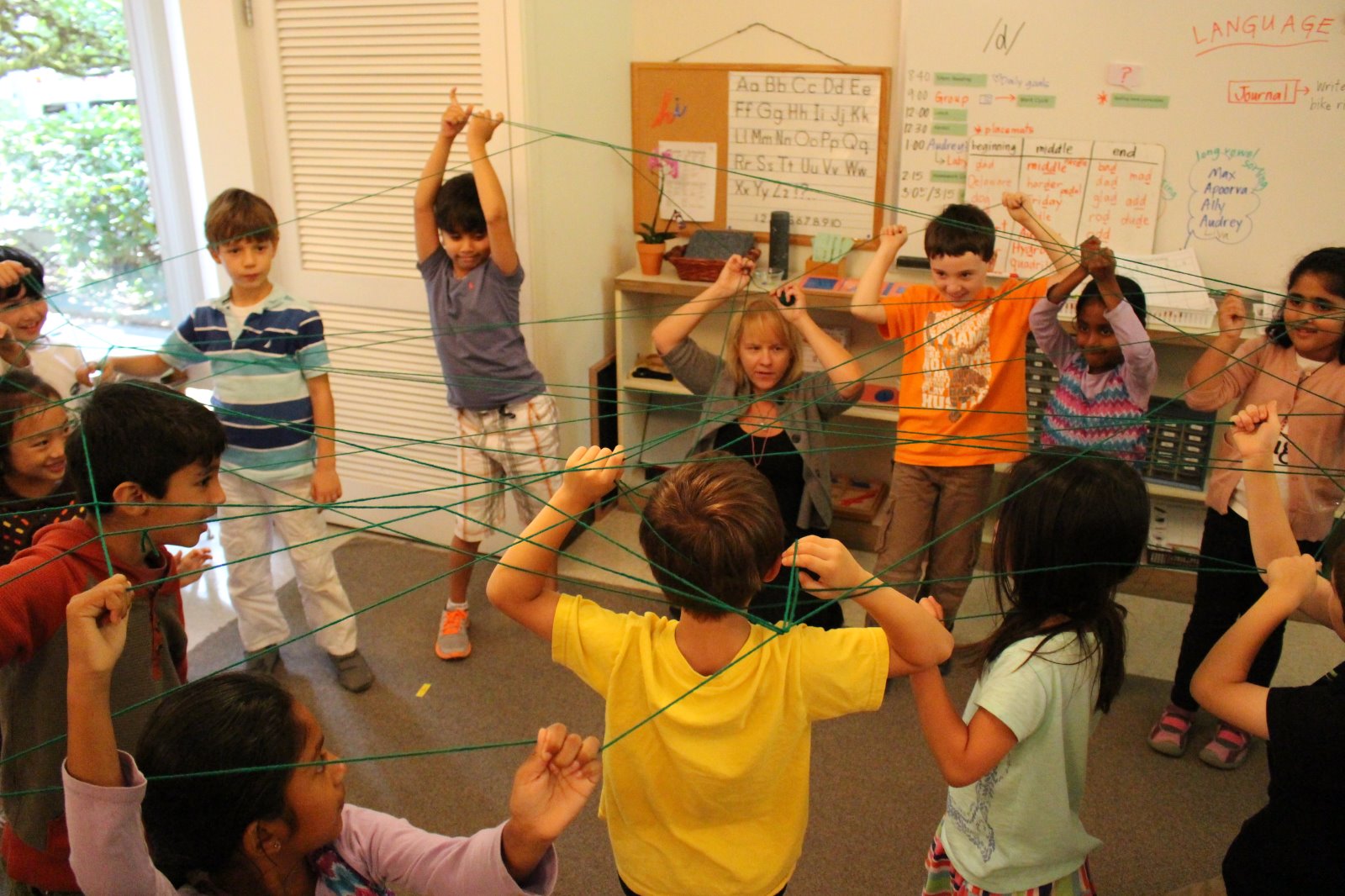
Sometimes in “sound games”, we make a chart with three columns for beginning, middle, and end placement of the sound in a word. In the past, as a primary extension, I have used a ball of yarn passed across a circle of our community to connect all these sounds together; I started and ended the circle, and at the end, we lifted and released our yarn to make a crazy shape. Currently, I ask children to offer a word with the sound in it, identify its location (beginning, middle, or end) in the word, and challenge the child to use the word with the sound in a sentence. This primary extension challenges children to understand, use, and create meaning from sounds. A secondary extension might be making a chart of their own words the following week, as a way of measuring memory of the lesson and continued application.


Maria Montessori’s phonics materials, which are often used first in 3-6 year-old classrooms, are integral to many 6-9 year-old’s confidence with both writing and the decoding process involved in reading. These materials have phonemes such as short vowels in one color (blue, to match the vowel color of the Movable Alphabet used in 3-6) with other letters in words in black. With consonant blends, the same two letters will be in red with other letters in black. 


Primary phonics card materials allow children to match vocabulary with an image card, while elementary phonics card materials allow children to decode as many as ten different words with a shared phoneme. After being introduced to the materials, children feel confident working independently or sometimes collaboratively with a peer. They read the words aloud to an adult, and sometimes they will challenge themselves in a self-selected manner in order to ingrain the vocabulary more deeply.


Word study encompasses many different functions of language, from syllabication to synonyms to rhyming words to homographs. Children study root words with prefixes, root words with suffixes, and compound words. The comprehensive Word Study Skyscraper made by Montessori Research and Development contains 5,000 matching cards, with each concept including up to ten drawers each for multiple practice. 


This Montessori material encourages children to broaden and deepen their sense of the English language, especially with the use of reference materials such as a children’s illustrated dictionary and thesaurus. Children may also challenge themselves in a self-selected manner by writing sentences or sets of words.


Finally, Montessori grammar is a beautiful endeavor in storytelling that Maria Montessori designed with her ever-present eye for detail. Each of the nine grammar symbols – noun, verb, article, adjective, adverb, pronoun, preposition, conjunction, and interjection – has its own color, shape, and story. For example, the story of the noun is about one of the biggest things on Earth – the Great Pyramid of Giza. The story of the verb follows the exciting adventures of a red sphere, which most children see (and treat!) as a ball. With the exception of the article and adjective – which, together with the noun, are introduced as the Noun Family story – each symbol has its own impressionistic key experience. A miniature environment such as a farm is often used in a Montessori 3-6 or 6-9 classroom as a physical place for children to make meaning with parts of speech.


Just as Montessori children come to recall the color coding of the bead cabinet and the stamp game, they enjoy remembering the shapes and colors of the grammar symbols, eventually coding them in written form on paper using a grammar stencil. (Again, Waseca makes a great one that is accessible for small hands.) Children get creative and have fun while learning, making connections and discoveries as they construct meaning from the world around them. 


The children featured here are reacting to eating a slice of grapefruit, as part of our Noun Family lesson. One offered this sentence: The sour grapefruit is disgusting.

Sunday, November 15, 2015

Practical Life Activities Engage the 6-9 Child

In the Lower Elementary Montessori classroom, students enjoy a balance of Language, Cultural, and Math studies using concrete academic materials designed by Maria Montessori over a hundred years ago. In addition, children ages 6-9 enjoy hands-on Practical Life work which includes:
  • sorting activities (which is a pre-math skill),
  • pin-poking shapes, such as a continent or country puzzle piece (which aids in handwriting), 
  • sewing, 
  • playing a melody harp (which gives a gentle calm to the bustling classroom environment), 
  • cooking food to share with the class, 
  • making designs on a geometric board with colorful rubber bands, 
  • building architectural models of real buildings which we are currently studying, 
  • gardening (or watering indoor plants during winter months), 
  • doing yoga exercises (asanas) with a partner or by oneself,
  • and walking a peace labyrinth. 

Practical Life activities build a child’s motor development from fine to gross -- strengthening both the pincer grip involved in legible penmanship and the patience needed to remain engaged with a project for a length of time. Practical Life also provides students with opportunities to explore their senses and enjoy activities related to the life of the community. Practical Life is indeed a “practical” skill which the child notices improves the more s/he practices it. A child is intrinsically motivated to cook, to sew, or to build. 


This type of activity grounds a person emotionally and physically, allowing him/her the space and time to make something beautiful, delicious, or intricate. In this way, the spiritual life of the Montessori student blossoms, in giving to others and in caring for oneself. Practical Life is the essence of Montessori's Peace Education.