Showing posts with label physical. Show all posts

Tuesday, December 31, 2019

What the Hand Does, the Mind Remembers


“What the hand does, the mind remembers.” – Dr. Maria Montessori


Children remind me that they learn with their hands, something Dr. Montessori understood through quiet observation over a century ago. This continues to be true in the current time of digital technology (literally: tools used by the hands) and an adult focus on abstraction as a metric of success. I have grappled with the inclusion of technology and testing in the Montessori classroom, in both private and public charter environments, and I continue to believe that they are incongruous with the beautiful and patient process of a child learning by holding actual objects – clay, fossils, fern fronds – with their hands.

“Do not tell them how to do it. Show them how to do it and do not say a word. If you tell them, they will watch your lips move. If you show them, they will want to do it themselves.” – Dr. Maria Montessori

A few years ago, I asked a mother of one of my students to come in and demonstrate how she makes her own kombucha. There were simple ingredients and a live bacteria, which we stored in our room for weeks and watched grow, documenting its bubbling surface and the layers that it formed in a controlled environment. It is much easier to just buy a bottle of kombucha at a store, however the children looked forward to being a part of the process – using gloves to touch the SCOBY, selecting the flavors to add. Convenience is not always possible nor preferable. It often stalls understanding.

"The senses, being explorers of the world, open the way to knowledge." – Dr. Maria Montessori


In the Montessori learning environment, especially the expansive Cosmic Curriculum, there are many varieties of concrete materials – from the wooden Bohr diagram modeling the inside of an atom to the Timeline of Life with era boxes full of fossils to the Land and Water forms (used with colored water poured from a jug). Many of these initial materials have extensions which allow interested children to go deeper. For example, many children choose to make their own Land and Water booklet with brown and blue paper, or (in this case, shown above) models formed by painting dried clay models.

When I think about the ways in which public education (and, often, adult thinking in general) prioritizes large quantities of superficial, one-time-only lessons – some of which are never reviewed nor returned to – I feel thankful that Montessori education functions in the exact opposite manner. Children are encouraged to go deeper, to be reiterative, to be creative with a concept, making the trench of the neural pathways surrounding it that much further ingrained.

“Education is a natural process carried out by the child and is not acquired by listening to words but by experiences in the environment.” – Dr. Maria Montessori


Children learn about Parts and Kinds in Montessori education, from math to language to science:

Parts of the Atom and Kinds of Atoms

Parts of a Line and Kinds of Lines

Parts of Speech and Kinds of Words

Children are attracted to the largest things and the smallest things. When we study the Coming of the Earth, we find an inter-relatedness with the Inner Earth and the Plate Tectonic activity that caused and causes land forms to exist, that allowed animal and eventually human migration to occur. Children are fascinated by superlatives: the highest, the furthest, the smallest, the coldest, the hottest. Again, it would be easier to simply purchase a model of a volcano from a craft store. However, witness these children forming volcanoes with their own hands!

“The hands are the instruments of man’s intelligence.” – Dr. Maria Montessori


It is amazing to be alive, and children in Lower Elementary also come to a knowledge that death is something that belongs to all things. We study life cycles of living things, such as a tree or a jellyfish, and we also know where our Universe is in its own lifespan. (Like me, it’s middle-aged!) This knowledge of the ephemeral quality of nature is deepened when children see the Timeline of Life, specifically how old the world is, how old other organisms are (like the jellyfish, one of the longest lived creatures on the planet), and how young we humans are as a species. When we study the life cycle, we see the same phases and know that each organism is unique and special.

“The human hand allows the mind to reveal itself.” – Dr. Maria Montessori


One of the most inspiring things to see is what children create from their own imaginations. When they use geometric building blocks as a Practical Life activity, they are resting their reading mind and engaging their body – their kinesthetic and tactile intelligences. They are using the concept of gravity when they balance an arch on a cone. They are using the concept of symmetry when they build a structure out of rectangular prisms, pyramids, and cylinders. Mainly, though, they are free to experiment, make mistakes, try again, and eventually hopefully innovate while creating an architecture of their own happiness.

Friday, May 6, 2016

Vitamin N

Recently, Richard Louv has written some of the most important books for parents and educators about the link between self-regulation, happiness, and success (in a holistic sense) and nature for children: Last Child in the Woods -- Saving Our Children from Nature Deficit Disorder, The Nature Principle, and his newest (released in April 2016) Vitamin N. Vitamin N is Nature, the ingredient so crucial for children to become competent, independent, and self-realized beings by integrating their physical, spiritual, emotional, and social needs in an environment where they are free of interference from adults.


I cherish and feel grateful for the existence of a natural space not one mile from our school where my students and I venture several times per year -- at least once per season -- to develop Vitamin N and nurture our spirits. We do this through free play in the forest environment, constructing (and often deconstructing) a fort made from a fallen tree. In this same area, past classes of mine have also learned about the necessity of the canopy -- the mixed age trees which mirror the mixed-age Montessori classroom -- for the survival of all biological life in the woods. Like the forest, we need all of our skills and difficulties in order to be the dynamic class that we are.


Each child receives her own tree under which she can see the world existing in its own rhythm and growing at its own pace, just as children do.


Students take their journals to a space that belongs only to one child at a time -- the nearest being ten to twenty feet away -- and soak in the environment through writing and art, sometimes using dirt or leaves to color their drawings. They write about what comes to mind about the natural world, and how the world entered their senses.


They touch nature, and by doing so, they return to themselves. This is what Maria Montessori envisioned with her Erdkinder program, and it is also how we maintain an authentic and impactful Montessori education. Louv cites Martha Farrell Erickson -- developmental psychologist and author of Together in Nature: Shared Nature Experience as a Pathway to Strong Family Bonds -- who advises parents and children to unplug from technology to create "an opportunity for ... affective sharing" to impact a child's lifelong development. Children need nature and a nurturing connection to their loved ones more than they need social isolation via electronic devices.

Here is a brief sampling of ideas for how to increase your child's intake of Vitamin N (Nature):
  • Put nature on the calendar -- just as you would schedule vacations or sporting events.
  • Think of nature as enrichment time -- not just after school classes, music lessons, and summer camp.
  • Turn your commute into a nature safari -- play I Spy with cloud formations, trees, and wildlife. Read signposts for land, water, and sky. Better yet, walk to school once per week, if you live close enough.
  • Play hooky -- take a day off work and let your teacher know you and your child will spend the day in the natural world re-connecting. Your child might take photos to share with classmates upon her return!
  • Stash a G.O. (Go Outside) bag in your car -- with compass, binoculars, water bottle, and hiking shoes -- so your family can be spontaneous and Go Outside at a moment's notice.
  • Recognize that boredom isn't a negative -- a child remembers best the unexpected adventure of the natural world.
  • Be the guide on the side -- ask questions of your child to elicit her logic and imagination, and resist the adult desire to control by answering these questions. This empowers your child and models curiosity over expertise.
  • Stay up late on Friday and Saturday night, and study the constellations. Your child may already know the ancient stories in the stars.
  • Paint with mud or leaves.
  • Press flowers between the pages of a heavy coffee table book you rarely open, using wax paper to protect your book.
  • Build a rock cairn.
  • Let kids take appropriate risks (walking on logs, for example) to build confidence, gross motor control, and resilience.

Sunday, November 15, 2015

Practical Life Activities Engage the 6-9 Child

In the Lower Elementary Montessori classroom, students enjoy a balance of Language, Cultural, and Math studies using concrete academic materials designed by Maria Montessori over a hundred years ago. In addition, children ages 6-9 enjoy hands-on Practical Life work which includes:
  • sorting activities (which is a pre-math skill),
  • pin-poking shapes, such as a continent or country puzzle piece (which aids in handwriting), 
  • sewing, 
  • playing a melody harp (which gives a gentle calm to the bustling classroom environment), 
  • cooking food to share with the class, 
  • making designs on a geometric board with colorful rubber bands, 
  • building architectural models of real buildings which we are currently studying, 
  • gardening (or watering indoor plants during winter months), 
  • doing yoga exercises (asanas) with a partner or by oneself,
  • and walking a peace labyrinth. 

Practical Life activities build a child’s motor development from fine to gross -- strengthening both the pincer grip involved in legible penmanship and the patience needed to remain engaged with a project for a length of time. Practical Life also provides students with opportunities to explore their senses and enjoy activities related to the life of the community. Practical Life is indeed a “practical” skill which the child notices improves the more s/he practices it. A child is intrinsically motivated to cook, to sew, or to build. 


This type of activity grounds a person emotionally and physically, allowing him/her the space and time to make something beautiful, delicious, or intricate. In this way, the spiritual life of the Montessori student blossoms, in giving to others and in caring for oneself. Practical Life is the essence of Montessori's Peace Education.


Sunday, May 6, 2012

Honoring the Physical Aspect of the 6-9 Child

Most forms of education focus primarily on the intellectual, but education is not limited to math, language, and cultural studies. It also encompasses an education of the senses, which in Montessori education includes art, fine motor (such as pouring, drawing, and writing), and gross motor development. Physical education evolves through freedom of movement, exploration of nature, fitness, and hand-eye coordination. As Montessori said, “Since it is through movement that the will realizes itself, we should assist a child in his attempts to put his will into action.”
Physically, the 6-9 child has longer limbs and strong muscles, is more resistant to disease, and shows a fascination with anatomy and all kinds of bodily functions, noises, and/or scatological jokes.  The Montessori environment appears most different from traditional educational settings in its physical dimension. Visitors notice that students move freely, often engaging in individual or partner work, rather than all students facing a teacher. 
Maria Montessori, a scientist trained in observation, revolutionized educational practices in the early 20th century when she announced, "free choice is one of the highest of all the mental processes." She quickly clarified in her involvement with street children of Rome, Italy, "To give a child liberty is not to abandon him to himself… To let the child do as he likes when he has not yet developed any powers of control is to betray the idea of freedom…The essence of independence is to be able to do something for one’s self." Freedom within limits, choice within order, and exploration within sequence are core to the Montessori method, yet above all exists respect for the child.

Prior to Montessori, education in America was heavily influenced by John Dewey, who modeled learning after industrial mass production.  Sadly, even now in the early 21st century, public education is dominated by a business model that treats children like products. Maria Montessori was ahead of her time in valuing the child as a source of inspiration, not simply a by-product of testing.  Montessori observed a child's need for physical contact with materials in exploration. As Montessori said so eloquently, "If teaching is to be effective with young children, it must assist ... independence… activities which they can perform themselves ... Any child who is self-sufficient... reflects in his joy and sense of achievement the image of human dignity, which is derived from a sense of independence.
The 6-9 child has an enhanced sense of personal space and spatial relationships. Montessori classrooms are tailored to the physical development of the child.  Shelves, desks, and materials are at a child’s level, and freedom of movement is incorporated to refine gross and fine motor skills and respect the child’s desire to have physical control over objects.  Materials are sequential, organized, attractive, and accessible to the child. One of the main tenets of Montessori education is the prepared environment and teacher as guide. As Maria Montessori said, "The environment must ... lend interest to activity and invite the child to conduct his own experiences...Education is a natural process carried out by the human individual and is acquired not by listening to words, but by experiences in the environment."  

Montessori also said, "No social problem is as universal as the oppression of the child." What other education reformer has ever been so on the side of the child as Maria Montessori? She pre-saged our modern predicament where the activity level of children becomes an issue of control for adults. In Montessori classrooms, the power center of the adult is transformed to the individual and the community, each respecting one another through the physical realm. Montessori education values, among other things, the physical life of the child. In traditional classrooms, children are confined to chairs and desks to engage in simultaneous activities under the supervision of a teacher. In a Montessori classroom, as Montessori herself described, “the environment itself will teach the child, if every error he makes is manifest to him, without the intervention of a parent or teacher, who should remain a quiet observer of all that happens.” 

How is this possible? As a scientist, Montessori followed the scientific method of observation, hypothesis, and experiment. Her values were the same as those of current Montessorians: environment, independence, and experience. They work together in many capacities, for example: at PE, lifting a parachute together.
The prepared environment allows students optimum freedom of movement through sequential organization of materials which are self-correcting, enhancing the child's independence. In addition, students frequently arrange materials at rugs on the floor. At Eton, on one of the first days of school, students attend a rules assembly that illuminates ways in which the physical aspect of the child is honored: interdependence of mind and body, respect and care for the body, refining and strengthening physical skills, and purposeful movement. As Montessori said, “Seemingly simple acts of unrolling a rug, carrying a work on a tray, keeping all material within a space, and replacing items at the end of a work are practices not only in diligence but in coordination and concentration… We must, therefore, quit our roles as jailers and instead take care to prepare an environment in which we do as little as possible to exhaust the child with our surveillance and instruction.”

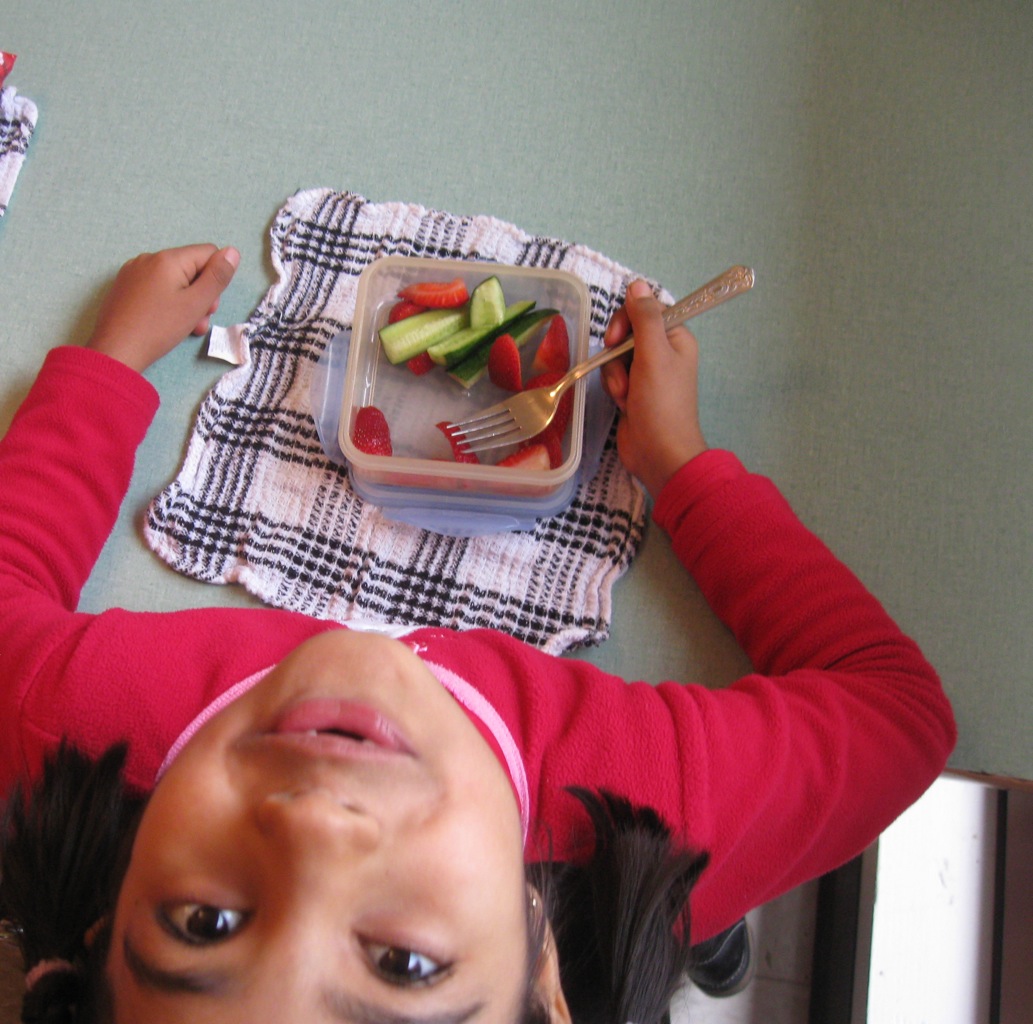
Independence is key to the 6-9 child’s development, however independence does not mean unlimited freedom. Lower elementary students use work plans in addition to sequential materials, in order to hone time management skills. They are in charge of their learning, what Montessori called “auto-education”: “The child, in fact, once he feels sure of himself, will no longer seek the approval of authority after every step.” Many materials (such as rugs, scales, and pattern blocks) encourage fine and gross motor development. Students learn to listen to their bodies and have snack when their bodies require it. Children no longer ask, “May I have snack?”  They have placemats and know how to wash their hands.
Working, interacting, and eating are personal experiences. A prepared environment is scaffolding for self-determination learned through independence and strengthened through experience. Maria Montessori understood over a century ago that “growth comes from activity, not from intellectual understanding.” Montessori education is not memorized knowledge but respect for all aspects of a person: intellectual, emotional, social, spiritual, and physical.  Montessori charged us to “respect all the reasonable forms of activity in which the child engages and try to understand them… Watching a child makes it obvious that the development of his mind comes through his movement.”

Current educational and scientific research corroborates Maria Montessori’s hundred-year-old vision, as author Richard Louv explains in his book Last Child in the Woods: Saving Our Children from Nature-Deficit Disorder. Louv notices that “within the space of a few decades, the way children understand and experience nature has changed radically…Today, kids are aware of the global threats to the environment—but their physical contact, their intimacy with nature, is fading.” Louv connects avoidance of direct experience in nature with a societal sense of doom for forests and deserts, oceans and lakes which previously evoked joy and solitude. Students plant herbs and weed in gardens, have lessons in the outdoor habitat, and run free at recess and during PE under evergreen trees that reach a hundred feet in the air. 
Without this daily contact with the natural environment, Louv warns, “the young spend less and less of their lives in natural surroundings, their senses narrow, physiologically and psychologically, and this reduces the richness of human experience.” Louv calls this modern phenomenon “nature deficit disorder,” a term seemingly in-line with common diagnoses for those whose energies would benefit from both freedom and structure. Louv reminds us, “Thoughtful exposure of youngsters to nature can even be a powerful form of therapy for attention-deficit disorders and other maladies. As one scientist puts it, we can now assume that just as children need good nutrition and adequate sleep, they may very well need contact with nature.”