Showing posts with label order. Show all posts

Wednesday, January 1, 2020

The First Great Lesson: the Coming of the Universe


“Let us give the child a vision of the whole universe… for all things are part of the universe and are connected with each other to form one whole unity.” – Dr. Maria Montessori


One of the hallmarks of the Lower Elementary Montessori classroom is the sequence of Great Lessons about the Coming of the Universe, Earth, and Humankind as central to the scientific studies in the Cosmic Curriculum. This is where concepts from physics, chemistry, and astronomy are introduced -- often via experiments or easily replicable demonstrations. This is where myths from cultures across place and time are shared; this is where the child begins to wonder about the grandest question: how did the universe originate?

“It is not enough for the teacher to love the child. She must first love and understand the universe.” – Dr. Maria Montessori


While respectful of global belief systems, Montessori education in the First Great Lesson – the Coming of the Universe – is based solidly in science. In fact, the juxtaposition of cultural myths and evolving hypotheses helps children ages 6-9 delineate what is factual and what is imagined, what is provable and what is improbable.

“The things he sees are not just remembered. They form part of his soul.” – Dr. Maria Montessori


These experiments and materials help the child see the inter-relationship between the unfathomably large multiverses and the smallest known spark of life, the atom, made up of even smaller particles – protons, neutrons, and electrons. Children are excited to see the order in this infinitesimal set of concentric circles and to use materials to recreate this brilliant structure of the building blocks of matter, the things that constitute stars and bananas and mountains and babies.

“Regard the child’s intelligence as a fertile field in which seeds may be sown, to grow under the heat of flaming intelligence.” – Dr. Maria Montessori


Freedom of movement in Montessori education is not only the ability of children to work on mats, as well as tables. Freedom of movement is not only their choice within limits of sequential shelf materials to grasp math, language, and science concepts. Freedom of movement is not only their right to work alone or with a partner; it also means that children can freely move between concepts. The Parts of an Atom connects to experiments in osmosis to pin-poking constellations or drawing them using oil pastels. This freedom of movement in thought stimulates the imagination and makes space for the connections that exist amongst all things over time and through space.


Sunday, February 10, 2013

Curriculum: Math Operations and Montessori Materials

One of Maria Montessori’s great contributions to education – aside from her Peace Education model that honors the child’s rights and dignity – is the construction of coherent, concrete manipulatives that reinforce place value and base-10 patterning in mathematics. Her math “games” are a gift to model learning.

In years 3-6, Montessori students are introduced to various beautiful materials which offer visual-spatial representations of number. A giant vanity of beads hangs in chains of various length, as in the parlor of a queen. The chains drape vertically as bracelets of squares, and numerical necklaces lay in cubic strands on wooden terraces. Students are introduced to math operations and the concept of place value with the golden beads, which are made of either glass or wood. Maria Montessori observed that children appreciate beauty and care for objects that are fragile and valuable. She entrusted children with these learning objects, often giving them trays on which to carry the materials around an environment, from the place where the object "lives" in the classroom environment to the mat or rug where a child's learning takes place.

With ages 6-9, the stamp game is introduced. A box with four vertical sections (units, tens, hundreds, and thousands), the stamp game contains wooden stamps painted in green, blue, and red. It also reinforces place value in each numeral family – simple, thousands, million, billions, etc. This material can be used to teach all math operations (addition, subtraction, multiplication, and division) by allowing the child to develop understanding of the nature of “exchange” (trading ten unit stamps for one ten stamp, for example).  Vertical stamp games – “bead frames” in the form of colored beads movable across a horizontal wire – demonstrate these concepts in upright form. 
In Montessori classrooms, students use hands-on materials to explore math operations. Introductory lessons for all operations are often practiced first with the stamp game. After the initial lesson, a child may work autonomously either by him/herself or with a partner.  As Montessori said, "Education is a natural process carried out by the human individual, and is acquired not by listening to words, but by experiences in the environment."
Two materials exist that excite students learning multiplication and division operations: the checkerboard and the test tubes (also called “racks and tubes”). Very similar to the stamp game, the checkerboard reminds the user of place value – while also seeming similar to a game. Students practice each level of sophistication, starting with a single-digit multiplier. They enjoy exchanging bead bars and eventually moving their products diagonally. The multiplicand extends to the billions place and the multiplier to the thousands, with multiple-digit computation manipulated with the same colored unit bars that the child found at ages 3-6 with the bead cabinet. To a child, it looks like you are playing checkers, when you're actually multiplying large numbers! 

The test tubes are arranged like the racks in a chemist’s lab, reinforcing place value yet again with each family of colored beads set in tubes with a dividend into the millions place, each house in grey, black, or white bases. “Exchanging” happens with the kinesthetic power of a banker. The idea of “banking” continues in the multiplication bank game and the money game. Students enjoy choosing an international name as they play banker with one to three players. Children love games, and Montessori devised a very crafty way to inspire interest in math by offering endlessly fun experiences with trading, exchanging, and playing with numbers.


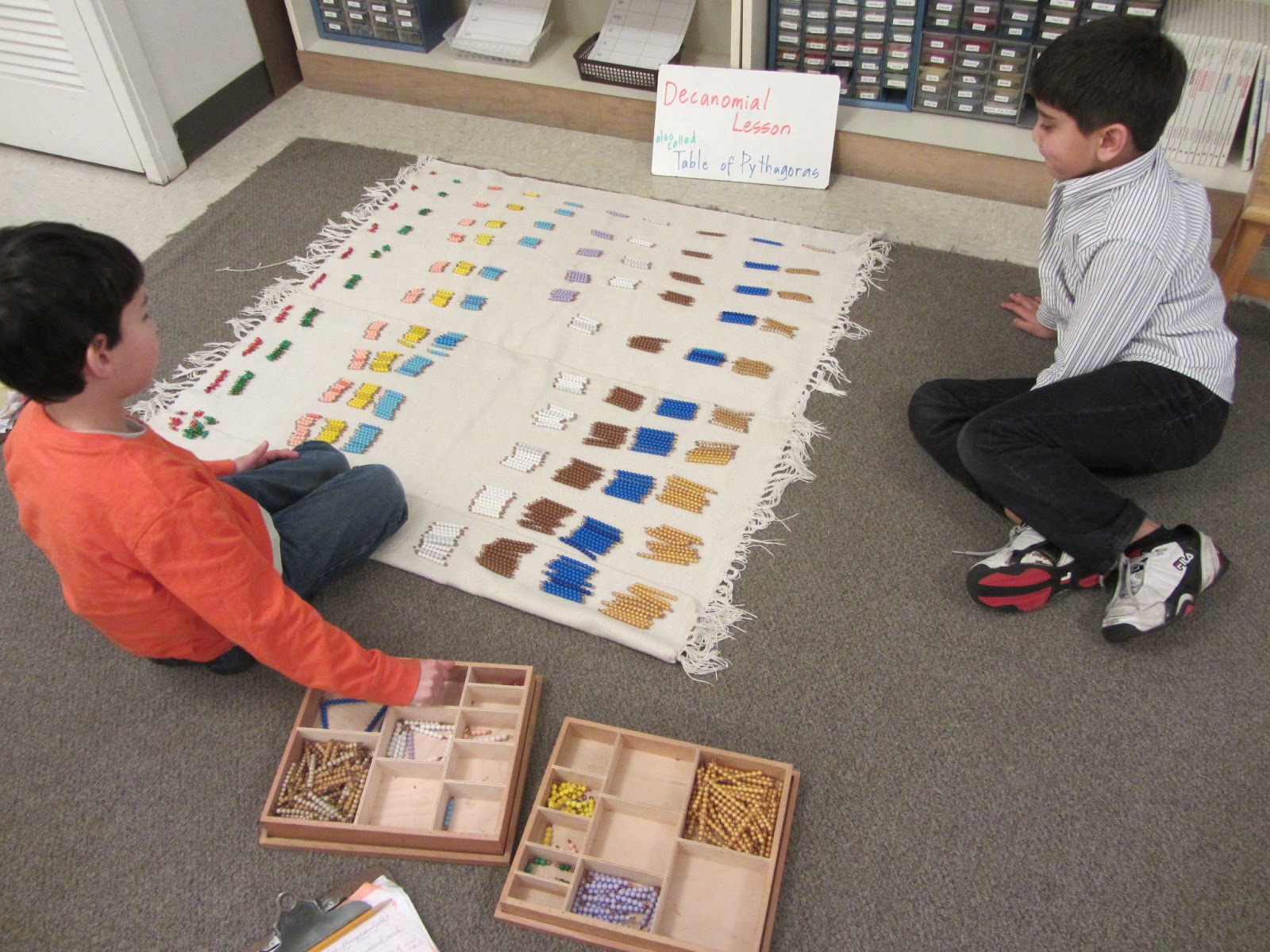
Still other materials in the math curriculum demonstrate Maria Montessori’s genius at connection beauty, intellect, and play. The Decanomial (also known as the Table of Pythagoras) can be constructed by students on two rugs, then views from an eagle-eye perspective. The Decanomial uses the same colorful beads found in other materials (such as the bead cabinet and checkerboard) to construct a visual multiplication table. Children take great care to make sure that their rows are parallel and orderly. At the end, they often notice the “backbone” of the table on the diagonal forms the squares of numbers, while all other multiplication facts form rectangles. This introduces a concrete lesson about exponents and helps many students with their multiplication math facts – by inviting them to count and see the numeric value (rather than simply abstract a “trick” taught at home by a well-meaning parent). Students follow this lesson with a plastic Decanomial, which they can also lay out on a rug with a partner.

Maria Montessori created so many materials that act as hands-on objects for students to learn math concepts.  She was a scientist and observer first, and she carefully considered what she noticed about children’s intrinsic motivations to learn: they enjoy beauty and order, they desire to play through work and to work as a form of "play", they care for materials that are fragile (in part because children like to be trusted), and they want to be in charge of their own learning. Maria Montessori bestowed onto children self-correction, logically-designed materials that they use every day in their classrooms.

Sunday, November 18, 2012

Honoring the Emotional Aspect of the 6-9 Child

Montessori education addresses the whole child, giving equal respect to a child's intellectual, emotional, social, physical, and spiritual needs. Many educational models focus mainly on the intellectual with lesser regard for the feelings, interactions, movements, and insights of students. One of the greatest gifts Montessori parents bestow on their children is honoring the emotional life of their child, letting him/her grow at an individual pace according to his/her strengths and areas of development. Parents and teachers may benefit from remembering Maria Montessori's belief that "it is the child who makes the man, and no man exists who was not made by the child he once was." It is our responsibility as adults to provide structures of routine and consistency, and it is imperative that we also step out of the child's way to allow for his/her own experiences.
Emotionally, the 6-9 child is becoming more independent than s/he was just last year, perhaps demonstrating rebellion against or resentment for what seems like default authority and assumed fact.  As Montessori said, "if an educational act is to be efficacious, it will be one which tends to help toward the complete unfolding of life. To be thus helpful it is necessary rigorously to avoid the arrest of spontaneous movements and the imposition of arbitrary tasks." This might fall under the category of a parent or teacher replying, "because I said so," a statement that children find (understandably) illogical. While the 6-9 child is socially very concerned with justice, emotionally s/he is simultaneously pushing at imposed limits and at times acting "out of character", though what s/he is really doing is developing character by striving toward individualism. 
While the 6-9 child is often concerned socially with belonging, emotionally s/he is chiefly concerned with personal happiness. In the Montessori classroom, social responsibility and emotional peace are balanced by daily, spontaneous problem-solving. The adult serves the child best by helping when needed and asking the child to "find a peaceful solution" or to accept that which s/he cannot change. This is a life skill that many adults still find challenging, yet children are frequently willing to discover a way of their own to make a situation feel better. This demonstrates the familiar declaration of the Montessori child: "I can do it myself," a kind reminder to adults not to intervene unless necessary.
An orderly environment has an emotional impact of great significance on the 6-9 child, who is branching out into a world that can feel scary and chaotic. The Montessori classroom is tailored to the height and viewpoint of a child, not to that of the adult. Work is arranged on low shelves sequentially, with care for beauty and space, so that a child can freely choose materials and use them (after a lesson with a teacher) without further need of an adult. S/he may also repeatedly use the work to encode learning and extend enjoyment, which has a direct impact on his/her happiness. The child feels empowered, free, and successful in the classroom, at times one of the few places in his/her world where s/he is truly trusted. Materials are self-correcting teachers of the child, who uses his/her hands to create understanding within the prepared Montessori environment. As Montessori said, "The children must be able to express themselves and thus reveal those needs and attitudes which would otherwise remain hidden or repressed in an environment that did not permit them to act spontaneously." The Montessori classroom is the child's work space, at all times accessible. 
The 6-9 child is pushing away from family a bit by meeting new people who have different skin colors, beliefs, and behaviors rather than more familiar characteristics. Montessori education values differences as well as similarities, as every child has his/her own personality, learning style, and confidence level. Children learn to look for comparisons between themselves, and Montessori guides encourage positive self-talk, a sense of striving for one's personal best, acceptance of emotions, and helpfulness within the classroom community. It can be a painful time for parents to pull back and allow your child to let go of your hand in order to strengthen his/her own sense of self. At school and at home, consistency and routine are vital to a child’s sense of stability. 
Solid partnerships in the two most important locations of your child’s life make him/her feel secure.  Montessori suggests that "an adult, if he is to provide proper guidance, must always be calm and act slowly so that the child who is watching him can clearly see his actions in all their particulars." Children absorb so much that we do not, having become with age and experience accustomed to our own posture, tone of voice, and volume. Teachers and parents model the behavior they wish to encourage in the child. When adults see a child suffering, we feel an inherent desire to either comfort or control the situation, perhaps recalling the way the child as a baby screamed in the supermarket. We were embarrassed or inconvenienced, but that child is no longer a baby. Truly respecting the 6-9 child involves asking what s/he needs at the time, rather than assuming or jumping instinctually to conclusions. 
Montessori understood that this requires mindfulness and restraint, since for adults "even to help can be a source of pride." We adults feel important when we help children, but children need to feel important by having a voice and a choice in their emotional lives. Often, when given a chance to reflect on his/her emotions, the 6-9 child will find a way to handle a situation that feels appropriate to him/her: taking some time to calm down, eating a snack (to balance blood sugar levels) or drinking water, practicing yoga in the peace corner, or journaling about a problem. Often children verbalize or demonstrate solutions that prove best to themselves, since each person knows best him/herself.
Maria Montessori implored guides trained in her method to avoid making demands of children and to instead use positive language -- telling what one wants rather than telling what one doesn't -- to model problem-solving and encourage emotional strength through words and non-violence. It is interesting, nonetheless, that Montessori admonished adults in two of her most famous sayings regarding students' emotional development: "Never help a child with a task at which he feels he can succeed," and "Do not erase the designs the child makes in the soft wax of his inner life." Montessori students are impressionable people who are learning -- from us, the adults in their lives -- how to balance emotions and express their feelings. Children need to see that adults are not perfect, that we make mistakes, that we feel regret, that we practice courage by apologizing, that we help other people, and that we strive for our own personal best.