Showing posts with label trust. Show all posts

Sunday, November 18, 2012

Honoring the Emotional Aspect of the 6-9 Child

Montessori education addresses the whole child, giving equal respect to a child's intellectual, emotional, social, physical, and spiritual needs. Many educational models focus mainly on the intellectual with lesser regard for the feelings, interactions, movements, and insights of students. One of the greatest gifts Montessori parents bestow on their children is honoring the emotional life of their child, letting him/her grow at an individual pace according to his/her strengths and areas of development. Parents and teachers may benefit from remembering Maria Montessori's belief that "it is the child who makes the man, and no man exists who was not made by the child he once was." It is our responsibility as adults to provide structures of routine and consistency, and it is imperative that we also step out of the child's way to allow for his/her own experiences.
Emotionally, the 6-9 child is becoming more independent than s/he was just last year, perhaps demonstrating rebellion against or resentment for what seems like default authority and assumed fact.  As Montessori said, "if an educational act is to be efficacious, it will be one which tends to help toward the complete unfolding of life. To be thus helpful it is necessary rigorously to avoid the arrest of spontaneous movements and the imposition of arbitrary tasks." This might fall under the category of a parent or teacher replying, "because I said so," a statement that children find (understandably) illogical. While the 6-9 child is socially very concerned with justice, emotionally s/he is simultaneously pushing at imposed limits and at times acting "out of character", though what s/he is really doing is developing character by striving toward individualism. 
While the 6-9 child is often concerned socially with belonging, emotionally s/he is chiefly concerned with personal happiness. In the Montessori classroom, social responsibility and emotional peace are balanced by daily, spontaneous problem-solving. The adult serves the child best by helping when needed and asking the child to "find a peaceful solution" or to accept that which s/he cannot change. This is a life skill that many adults still find challenging, yet children are frequently willing to discover a way of their own to make a situation feel better. This demonstrates the familiar declaration of the Montessori child: "I can do it myself," a kind reminder to adults not to intervene unless necessary.
An orderly environment has an emotional impact of great significance on the 6-9 child, who is branching out into a world that can feel scary and chaotic. The Montessori classroom is tailored to the height and viewpoint of a child, not to that of the adult. Work is arranged on low shelves sequentially, with care for beauty and space, so that a child can freely choose materials and use them (after a lesson with a teacher) without further need of an adult. S/he may also repeatedly use the work to encode learning and extend enjoyment, which has a direct impact on his/her happiness. The child feels empowered, free, and successful in the classroom, at times one of the few places in his/her world where s/he is truly trusted. Materials are self-correcting teachers of the child, who uses his/her hands to create understanding within the prepared Montessori environment. As Montessori said, "The children must be able to express themselves and thus reveal those needs and attitudes which would otherwise remain hidden or repressed in an environment that did not permit them to act spontaneously." The Montessori classroom is the child's work space, at all times accessible. 
The 6-9 child is pushing away from family a bit by meeting new people who have different skin colors, beliefs, and behaviors rather than more familiar characteristics. Montessori education values differences as well as similarities, as every child has his/her own personality, learning style, and confidence level. Children learn to look for comparisons between themselves, and Montessori guides encourage positive self-talk, a sense of striving for one's personal best, acceptance of emotions, and helpfulness within the classroom community. It can be a painful time for parents to pull back and allow your child to let go of your hand in order to strengthen his/her own sense of self. At school and at home, consistency and routine are vital to a child’s sense of stability. 
Solid partnerships in the two most important locations of your child’s life make him/her feel secure.  Montessori suggests that "an adult, if he is to provide proper guidance, must always be calm and act slowly so that the child who is watching him can clearly see his actions in all their particulars." Children absorb so much that we do not, having become with age and experience accustomed to our own posture, tone of voice, and volume. Teachers and parents model the behavior they wish to encourage in the child. When adults see a child suffering, we feel an inherent desire to either comfort or control the situation, perhaps recalling the way the child as a baby screamed in the supermarket. We were embarrassed or inconvenienced, but that child is no longer a baby. Truly respecting the 6-9 child involves asking what s/he needs at the time, rather than assuming or jumping instinctually to conclusions. 
Montessori understood that this requires mindfulness and restraint, since for adults "even to help can be a source of pride." We adults feel important when we help children, but children need to feel important by having a voice and a choice in their emotional lives. Often, when given a chance to reflect on his/her emotions, the 6-9 child will find a way to handle a situation that feels appropriate to him/her: taking some time to calm down, eating a snack (to balance blood sugar levels) or drinking water, practicing yoga in the peace corner, or journaling about a problem. Often children verbalize or demonstrate solutions that prove best to themselves, since each person knows best him/herself.
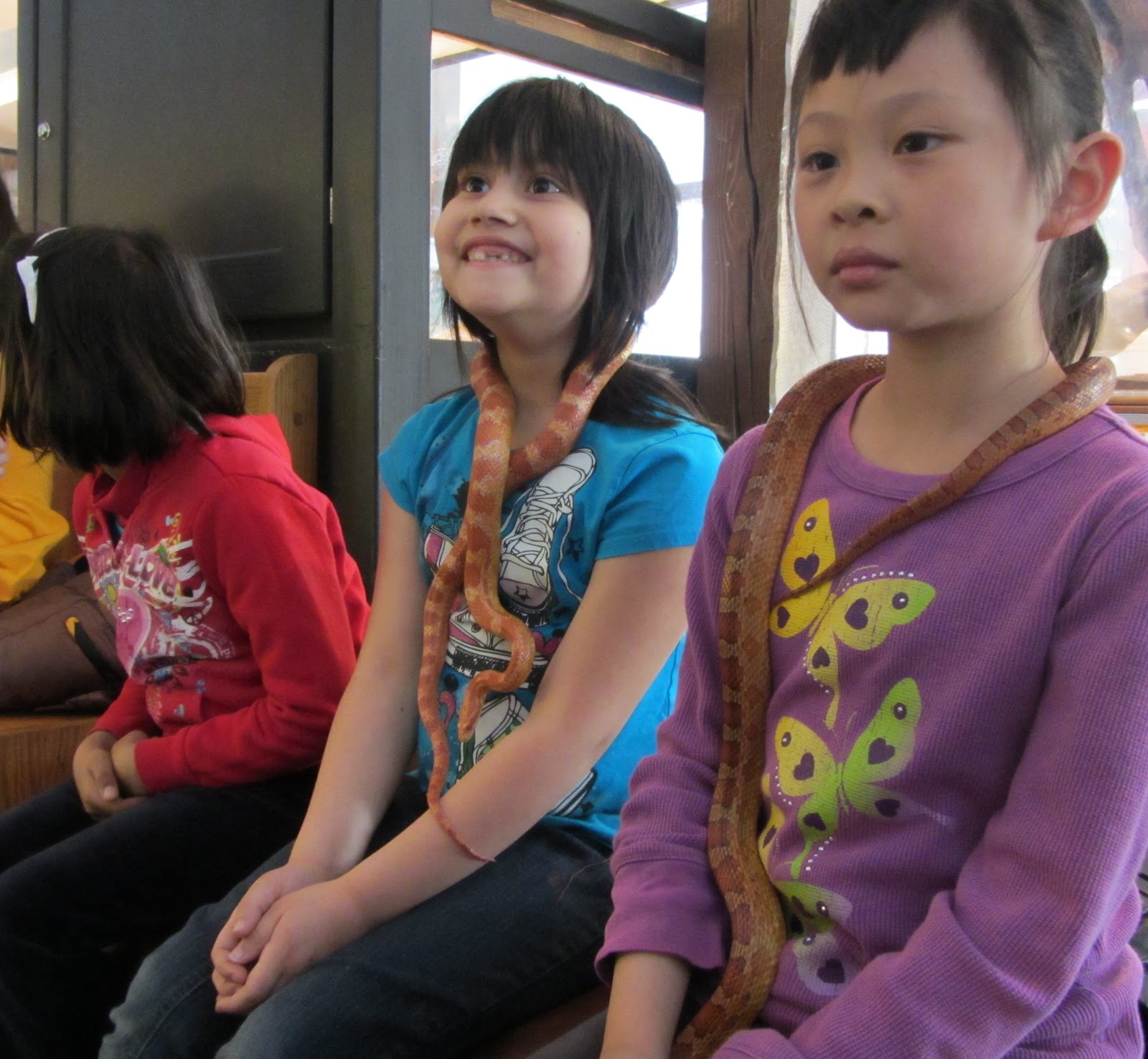
Maria Montessori implored guides trained in her method to avoid making demands of children and to instead use positive language -- telling what one wants rather than telling what one doesn't -- to model problem-solving and encourage emotional strength through words and non-violence. It is interesting, nonetheless, that Montessori admonished adults in two of her most famous sayings regarding students' emotional development: "Never help a child with a task at which he feels he can succeed," and "Do not erase the designs the child makes in the soft wax of his inner life." Montessori students are impressionable people who are learning -- from us, the adults in their lives -- how to balance emotions and express their feelings. Children need to see that adults are not perfect, that we make mistakes, that we feel regret, that we practice courage by apologizing, that we help other people, and that we strive for our own personal best.

Monday, May 7, 2012

Parent Involvement in Montessori Classrooms

Sometimes, parents wonder how they can be involved when their child attends a Montessori school, or any school for that matter. The truth is, any teacher loves to have parent support in the classroom, especially when the parent asks the teacher questions about how to do so. I have been fortunate to have parents whose schedules often allow them to participate as field trip drivers and chaperones, to volunteer to give weekly spelling tests or listen to students read, or to come into class to share an experience or special interest. 
One of the most important yearly events that students share with their classmates is their birthday celebration. A candle at the center of group represents the sun, and a globe represent the Earth. In the Montessori 3-6 classroom, many students sang a song as the birthday child carried the globe around the candle: "The Earth goes around the sun/ The sun/ The Earth goes around the sun/ It takes 12 months/ One year/ 365 days." In Montessori 6-9 classrooms, there are many variations. In my class, the child and his/her parents share photos and stories from each year of a child's life, and at the end of the group, the other students ask questions and sing "Happy Birthday". The birthday boy or girl often chooses to donate a new or used book to the classroom library, as his/her gift to the community.
Another opportunity for parents is to join their child for a healthy lunch and talk with his/her classmates.
At other times, parents offer to share about their profession (such as a mom who is a nurse) or a hobby, such as a dad sharing about a family's recent beehive operation. When their child participates as a "co-presenter", s/he feels a great deal of pride and leadership.
Parent volunteers in the classroom are so important, especially those who give spelling tests to students or listen to them read one-on-one. Parents learn how to listen for decoding and ask questions that aid reading comprehension. They also provide an extra set of eyes for observation of student assessment in reading, which is very valuable.


Sunday, April 15, 2012

Unconditional Parenting & Montessori

In reading Alfie Kohn's 2005 book Unconditional Parenting: Moving from Rewards and Punishments to Love and Reason, some passages have given me pause to reflect:
"We might say that discipline doesn't always help kids to become self-disciplined... There's a big difference, after all, between a child who does something because he or she believes it's the right thing to do and one who does it out of a sense of compulsion... if we place a premium on obedience at home, we may end up producing kids who go along with what they're told to do by people outside the home, too." (pp. 6-7)
Kohn discusses BF Skinner and Behaviorism, a tendency to focus solely on actions and not on the feelings nor thoughts behind them.  Montessori philosophy encourages self-discipline.  Teachers act as guides, respecting the child through use of inquiry in three-part lessons and discussion in groups.  Students engage with questions rather than parrot anticipated answers.  Through problem-solving and reading literature related to social skills, students give suggestions for finding peaceful solutions to problems. It is often helpful to ask a child a question and let him/her find an answer rather than making unsolicited demands or nagging.
"Perhaps you've met (adults) who force ... children to apologize after doing something hurtful or mean... So (they) assume that making children speak this sentence will magically produce in them the feeling of being sorry, despite all evidence to the contrary?... Compulsory apologies mostly train children to say things they don't mean -- that is, to lie." (p. 14)
A few years ago, a precocious student had a rough time respecting my assistant.  I spoke with the child after an unpleasant event between them and listened to his side of the story. I then tried to facilitate peace by asking him to apologize to my assistant, either in verbal or written form.  He said that he could apologize to her, but he wouldn't mean it.  I asked if he could consider ways in which he could be more respectful to her, instead.  He came up with many ideas, none of which involved pretending he was sorry when he wasn't.
Kohn quotes noted psychologists Richard Ryan and Edward Deci (also quoted by Daniel Pink in Drive) asserting that "children are born not only with certain basic needs, including a need to have some say over their own lives, but also with the ability to make decisions in a way that meets their needs", what Ryan and Deci term "a gyroscope of natural self regulation" which can be undermined by guilt, needless interference, physical force, criticism, and even praise: "a heavy handed (adult) does nothing to promote, and actually may undermine, children's moral development.  Those who are pressured to do as they're told are unlikely to think through ethical dilemmas for themselves" (pp. 58-59).  Lack of self-regulation also impacts, Kohn observes, personal health choices, social relations, interests, commitments, and acquisition of learning.  Alternatives are for adults to exercise restraint in interactions with children, remember to respect children as people, ask questions rather than make assumptions, separate emotional reactions from the child's will, and say "I notice" when observing behaviors rather than ascribing a positive or negative judgment.
One of the contentious suggestions that Kohn makes in this book and some of his others is that grading negatively impacts students.  He cites studies that demonstrate this and claims that "the more a child is thinking about grades, the more likely it is that his or her natural curiosity about the world will start to evaporate" (p. 80).
After hearing Kohn speak last fall, I shared some of his ideas with the students in my class at a class meeting, a democratic gathering where topics and suggestions are discussed.  I had noticed that when math fact and spelling tests were handed back for correction with a numeric grade on the paper, students compared themselves to one another, some bragging and some feeling disappointed in their abilities.  Some adults feel that competition is a natural part of life "in the real world" that children will eventually have to face, and while I agree with that unfortunate fact, I do not feel that grades as such need to be transparent to students.  I suggested a trial period where grades would be recorded by me but not shown on the paper, only the grammatical and mechanical corrections.  That was six months ago, and no one has complained about their absence.  In fact, I have noticed that students are less self-aware and more confident when given these protective options.  Our school reports S and S+ "marks" at the 6-9 level with extensive narrative descriptions that many contemporary education researchers advocate, as well.
Kohn offers some guiding principles for expressing unconditional love by avoiding rewards and punishments, which include keeping your eye on long-term goals, talking less and asking more, attributing to children the best possible motive consistent with the facts, saying yes more than saying no, and avoiding rigidity and hurrying a child according to your needs (p. 119-120).  Sometimes, we adults who have become accustomed to our own schedules expect the world to know our timetable and are flummoxed when traffic does not stop for us.  Plan ahead and know your child so that you can help him/her instead of asking for frequent adaptation to your expectations. This means avoiding over-planning and making sure, whenever possible, that your child's needs come first. For example, a child told me recently that he hadn't slept well the night before, and the reason he was late to school was that his mom let him sleep in so he would be alert.  I applaud this parent for thinking of her child's needs.  One of the most salient suggestions Kohn offers are three questions for adults to ask themselves regarding their speech and actions with children (and it also applies to our interactions with adults): why am I asking this, is it necessary, and how will the other person receive it (p. 158-160)?
Montessori education -- which provides a prepared, sequential, and orderly scope and sequence of curriculum -- gives students a range of choices for their auto-education.  We guides give lessons, yet much of the learning that happens in our classrooms occurs through the materials teaching the students as frequently as needed for absorption and as rarely as needed after abstraction.  Materials make great guides, because they do not praise nor punish, but simply offer a control of error, another of Maria Montessori's amazing insights over a century ago.  Autonomy does not mean independence but volition, and children are more willing and eager in situations where they feel they have choice.
As Kohn notes, "when teachers give their students more choice about what they're doing... the advantages include greater perceived competence, higher intrinsic motivation, more positive emotionality, enhanced creativity, a preference for optimal challenge over easy success, greater persistence in school, greater conceptual understanding, and better academic performance" (p. 169).  That is, after all, what every teacher wants for her students, what every parent wants for his child, and what every student wants for him/herself.