Showing posts with label integrated studies. Show all posts

Saturday, April 15, 2017

Montessori's Second Great Lesson: The Coming of the Earth


After the introduction of Montessori’s First Great Lesson: The Coming of the Universe, lower elementary children are eager to explore The Second Great Lesson: The Coming of the Earth. This study of the Earth begins, as the Universe study began, with cultural origin stories from around the world, as well as the evolving story of the scientists which involves facts, evidence, and the Scientific Method. It incorporates physics, chemistry, geology, and physical geography. Children learn about the conditions which existed that allowed land to solidify and water to form in the first place.


As in the Montessori 3-6 classroom, land and water forms are introduced in the 6-9 environment with greater detail and sophistication, and with different materials. In the 3-6 environment, children often pour water into shaped land forms to demonstrate land and water forms as opposites. For example, an island – which is land surrounded by water – is the opposite of a lake – which is water surrounded by land. This holds for the many other land and water forms studied in greater depth at the 6-9 level, such as isthmus and strait, cape and peninsula, etc.


Children are introduced to plate tectonics and discover how land forms (which we call continents) have been changing and moving on top of the crust of this planet for billions of years. This study helps us to discuss the eternal situation on this planet of climate change, which is affecting us as humans with great importance. Over the years, I have used various food items to demonstrate the three kinds of plate boundaries – transforming, convergent, and divergent. (This nomenclature also connects to terminology used in geometry lessons for some of the children, further deepening their neural pathways.) Whether I’ve used molasses, marshmallow fluff, or maple syrup with graham crackers, the learning environment smells sweet for several days. Children enjoy the texture of real materials as symbols of giant planetary processes.


The study of geology continues with the factors that allowed for plate tectonic activity – volcanoes and earthquakes. At the 6-9 level, children enjoy making their own exploding volcanoes (using baking soda, vinegar, and food coloring) and research famous eruptions to see how these natural disasters later affected animal and plant lives.


Long before the first life forms existed, rocks did, and children learn about the three main kinds: sedimentary, igneous, and metamorphic. Real examples of these rocks sit on our geology shelves waiting to be touched and understood. This photo shows an extension that involves creating a sedimentation jar, revealing the layers that these rocks make underneath our feet!


As with land and water forms, the continent puzzle map cabinet is introduced in Montessori 3-6 classrooms and used with more depth and detail at the 6-9 level. Children make their own maps of the continents, which provides both a direct aim (identifying land forms and water forms by name and shape) and many indirect aims: refining fine motor skill, connecting the child with places of relative distance, and conceptualizing the spiritual aspect of self in relation to land and water forms of such sizes and at such distances from one another.


The main purpose of the continent puzzle maps is not that a child will memorize all of the names and locations of countries in Asia, but that s/he begins to grasp his/her smallness within the infinite Universe, in terms of space, size, and time. Children often share the labor of this work with a friend and ask the other to hand him/her a certain country so that it may be traced, then labeled, then colored, then brought home to wallpaper one’s bedroom.


Finally, children continue learning about the Work of Wind and the Work of Water by studying the atmosphere, erosion, and weather. A fun way to explore these topics is to learn how to discriminate visually between different kinds of clouds, their shapes, and their meanings when seen above us. Some clouds portend rainy weather, others clear skies, and still others tell us humans on the ground what speed and motion the wind is taking 25,000 feet up in the sky. These photos demonstrate secondary extensions children make after first studying the three- or four-part cloud card materials. 


These hands-on activities both serve the multiple intelligences of different kinds of learners and ingrain the geographical concepts so that (just as with rocks and land and water forms) children make connections in nature or on trips with their families, as well as within a learning environment inside a building. After learning these initial concepts with the concrete Montessori materials, any location transforms into a classroom of the mind!

Sunday, November 15, 2015

Practical Life Activities Engage the 6-9 Child

In the Lower Elementary Montessori classroom, students enjoy a balance of Language, Cultural, and Math studies using concrete academic materials designed by Maria Montessori over a hundred years ago. In addition, children ages 6-9 enjoy hands-on Practical Life work which includes:
  • sorting activities (which is a pre-math skill),
  • pin-poking shapes, such as a continent or country puzzle piece (which aids in handwriting), 
  • sewing, 
  • playing a melody harp (which gives a gentle calm to the bustling classroom environment), 
  • cooking food to share with the class, 
  • making designs on a geometric board with colorful rubber bands, 
  • building architectural models of real buildings which we are currently studying, 
  • gardening (or watering indoor plants during winter months), 
  • doing yoga exercises (asanas) with a partner or by oneself,
  • and walking a peace labyrinth. 

Practical Life activities build a child’s motor development from fine to gross -- strengthening both the pincer grip involved in legible penmanship and the patience needed to remain engaged with a project for a length of time. Practical Life also provides students with opportunities to explore their senses and enjoy activities related to the life of the community. Practical Life is indeed a “practical” skill which the child notices improves the more s/he practices it. A child is intrinsically motivated to cook, to sew, or to build. 


This type of activity grounds a person emotionally and physically, allowing him/her the space and time to make something beautiful, delicious, or intricate. In this way, the spiritual life of the Montessori student blossoms, in giving to others and in caring for oneself. Practical Life is the essence of Montessori's Peace Education.


Friday, February 21, 2014

Reading Comprehension: My Favorite Fiction Character!


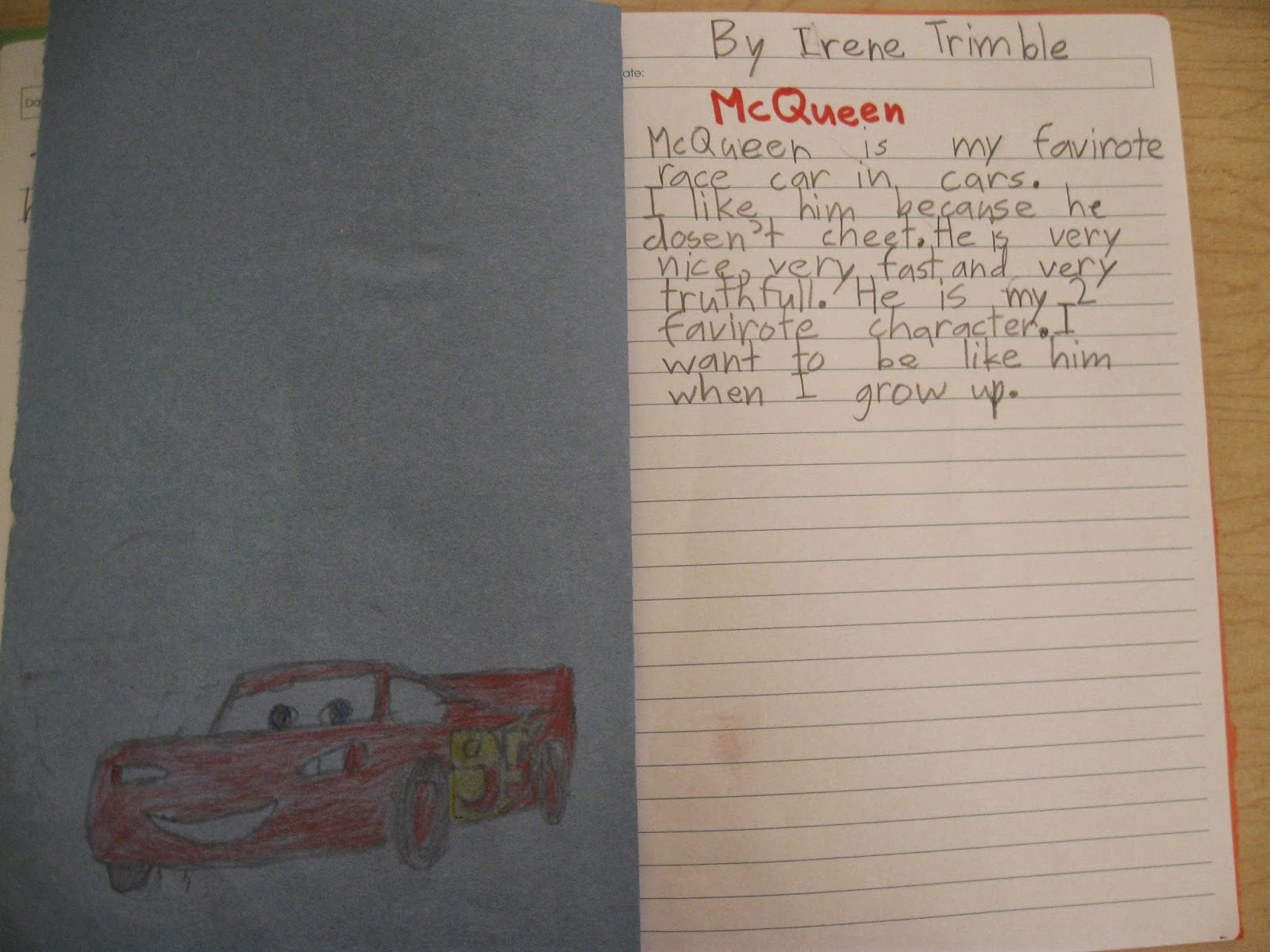
A homework project that provoked excitement in my 6-9 classroom was “My Favorite Fiction Character”. 
This was a two-week project. During the first week, students chose their top three favorite fiction characters and wrote about why they liked them. 
Was the character a hero or a villain? They were elated to share their writings and illustrations in class at homework sharing group.
During the next week, students designed a costume to wear for an entire day, dedicating themselves to the one fiction character they most admired. 
Children enjoy any excuse to dress up and embody others – such as Snoopy, Chet Gekko, and the BFG.

This project further encouraged students to write book recommendations (as a Literacy group activity) for peers and younger students. Nothing motivates a child to read something new like hearing about a good book from a friend!

Mind Webs and “Going Out”


Last fall, we began our school year with our first field trip to Magnuson Park in Seattle, the grounds of which were once an airfield – now a sanctuary for wetland wildlife and birds of prey. Maria Montessori advocated students “going out” of the familiar classroom atmosphere and experiencing the natural environment as observers. As a scientist, Montessori understood the value of approaching the world around us as explorers, uncovering knowledge with our senses.
With the help of three Magnuson Park docents, our class of twenty students broke into sub-groups to dissect owl pellets; to explore Nature’s Grocery Store on a short circuitous walking path through overgrowth; and to create their own nests using the same materials the local avian population uses. Children enhanced their fine motor skills with tools such as tweezers – pulling tiny rodent jaws from feathers and hair in the pellets. They employed their five senses as they imagined themselves searching for edibles in the environment and planning a soft bed for their eggs.
Upon returning to school from this wonderful expedition, we met altogether at Literacy Group to make a collective mind web. Graphic organizers (such as mind webs, charts, and graphs) honor visual and spatial learners, who may prefer to draw their thoughts and move in a non-linear fashion to express themselves. As an educator, I facilitated this Literacy Group by using a few simple materials: a large (three by three foot) swath of black butcher paper, white chalk, and a small pad of post-it notes. 
First, I drew a spider web with chalk on the black background. Then, I asked students to remember any details from the field trip to Magnuson Park and modeled writing these memories on the post-its. The reason I did this in a whole group setting was to reinforce auditory, visual, and graphic learning styles. Some students remembered things right away, while others offered their observations later, after hearing their peers’ perspectives. Very quickly, we had about forty post-it notes covering our web.
The second step was to group these recollections into categories. One of the benefits of using post-it notes (rather than simply writing a list on a board) was that students saw how ideas can move around in different formations. A few categories students identified were:
  • things about birds
  • what happened on the way to and from the field trip
  •  facts about animals
  • facts about Magnuson Park
  • sounds and smells
We ended our Literacy group with students working as partners to make their own mini-Mind Webs with black construction paper, chalk pastels, and post-it notes. They chose which categories they wanted to remember most and went into more detail. This is an example of how classroom studies and “going out” activities are integrated in the Montessori environment. Recent brain research describes how the act of recalling a learning experience embeds the acquired knowledge by stimulating the frontal lobe, where working memory and the faculty for organization reside!

Monday, May 7, 2012

Honoring the Intellectual Aspect of the 6-9 Child


Maria Montessori believed that human development is not upward, steady, and linear but “a sequence of births”, a series of formative stages.  She defined four planes of development for the child burgeoning into an adult: birth to age six, six to twelve, twelve to eighteen, and eighteen to twenty-four. As adults, we can look back upon our lifelong learning similarly, as an ocean of continuing knowledge nudged forward in ebbs and flows of discovery, reflection, and tangents of new interest. One of the many gifts you have given to your child with a Montessori education is a respect for the whole child, which includes not simply academic progress. 
When visiting a Montessori classroom, visitors often notice respect for others, value for peace and concentration, attention to spatial awareness, and love for the environment. In Lower Elementary, we focus on the beginning of the second sequence of a child’s rebirth, what Montessori referred to as a “state of security and tranquility”, through the intellectual, emotional, social, physical, and spiritual life of the child.  As Montessori said, “The elementary child has reached a new level of development. Before he was interested in things: working with his hands, learning their names. Now he is interested mainly in the how and why…the problem of cause and effect.”  
Intellectually, the 6-9 child is curious, imaginative, interested in sharing ideas, and as Montessori put it, “hungry for culture”.  Montessori acknowledged the “importance of feeding the hungry intelligence and opening vast fields of knowledge to eager exploration”.  The center of the 6-9 curriculum, Cosmic Education, emerges in story form and through experiments, arriving at a time when the child craves reasons for things. The Great Lessons at the 6-9 level – the Coming of the Universe, the Earth, and Humankind – spark the imagination by giving a brief glimpse of the whole universe and its contents, thereby whetting the child’s intellectual appetite.  
Montessori believed that “the child’s mental powers are now such that they not only expand but soar, rising to new heights”.  The Cosmic Curriculum, which begins with grand concepts such as physics, chemistry, astronomy, geology, and geography and gradually zooms in on botany, zoology, and the human experience.  These areas of the curriculum are studied by all ages in varying levels of sophistication. Science experiments are integrated, as we discuss the Scientific Method. Students work with hands-on materials such as beakers and microscopes to investigate for themselves gravity, magnetism, volcanism, and states of matter. 
Maria Montessori wrote, in her book To Educate the Human Potential: “Since it has been … necessary to give so much to the child, let us give him a vision of the whole universe. The universe is an imposing reality, and an answer to all questions…. All things are part of the universe, and are connected with each other to form one whole unity. The idea helps the mind of the child to become focused, to stop wandering in an aimless quest for knowledge. He is satisfied having found the universal centre of himself with all things.” 
The Montessori classroom is organized both beautifully and sequentially, so that to the naked eye of child and parent, everything a child encounters seems do-able. Information is simplified and studies are approached in small steps, so that students can delve into material year after year and always learn something new. Montessori explained that the environment is prepared this meticulously so the child may be “left in peace to bring an activity to its logical and natural conclusion (and experience) a great sense of achievement”.  
Montessori education is sometimes accused of being either too structured, or not structured enough.  Though this may be a matter of opinion, the intention of the prepared environment and the responsible freedom encouraged of Montessori students is for the child to interact with materials in a hands-on fashion to the ultimate satisfaction of his/her passions. This is when true learning happens.  Students are most productive and engaged when a work is self-chosen, founded on individual interest with the teacher sowing a maximum number of seeds so that a few may find permanent root in your child’s heart and mind.  
Freedom of movement and freedom of choice are inherent to the child’s ownership of his/her learning process, and your child has the luxury of continuing with a work at his/her own pace, for as long as he/she benefits from the pleasure of repeating and encoding the purpose of that activity. That said, Montessori teachers are notorious observers and record-keepers, who follow a scope and sequence that spans nearly twenty subcategories within math, language, reading, and cultural studies. We track the learning of each child individually, present lessons to small or whole groups, and address the variety of learning styles present in the classroom, committed as we are to the Montessori mantra "follow the child".  
All Montessori materials, in addition to providing concrete experiences of abstract concepts, are sequential, developmentally-appropriate, self-correcting, and often made of wood, glass or metal.  The purpose of self-correcting material -- such as language cards which match images or objects with words and/or definitions -- is to encourage a child's self-esteem and self-reliance.  The materials are the teachers, as much as are the guides in each room.  Lessons introduce materials and activities, yet most of the time children work alone or in partner groupings (of their own choosing) so that work appears to be a game, as Montessori believed "work normalizes the child".
Maria Montessori said, “Education is a natural process carried out by the human individual, and is acquired not by listening to words, but by experiences in the environment.”  This belief is demonstrated well with the use of math materials such as the Golden Beads, the Stamp Game, the Bead Frames, the Checkerboard, and Rack and Tubes (also called the Test Tubes).  These materials help reinforce place value, so that the child learns in increments about concepts such as "exchanging" by first trading individual units for the next greatest place value, tens, and so on. Many of us who attended traditional schools marvel at what seems now an obvious visual and kinesthetic experience, since we often learned an abstraction or formula prior to (or in some cases, completely without) sorting, counting, or even touching quantities of things. 
Montessori teachers at the 6-9 level would implore parents to allow the teaching to happen at school with the materials rather than confuse the process by demonstrating "tricks" at home, since a child may resist using the myriad of hands-on materials if shown something deemed "easier", which is in fact much more complicated and introduced at the culmination of the learning cycle. Three years within the breadth and depth of the 6-9 classroom allows a child a never-ending supply of interests and exploration and demonstrates how a lifetime could be spent learning more about these endless questions. 

Sunday, May 6, 2012

Curriculum: Geometry


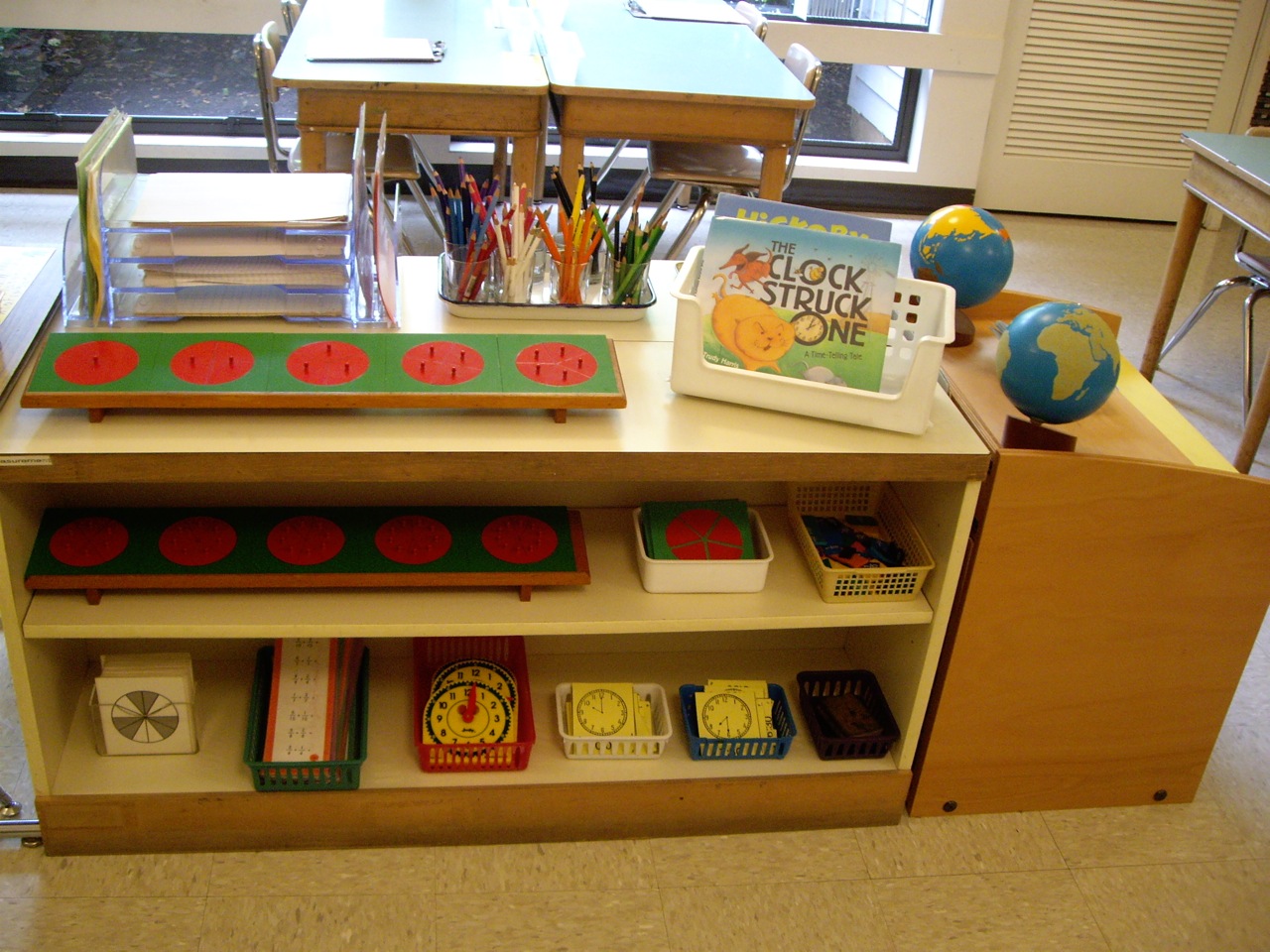
Students explore practical math work like geometry (as well as fractions, measurement, story problems, time, money, and decimals) through hands-on materials first, then gradually build toward abstraction. Maria Montessori devised such brilliant and attractive materials as the geometric solids (which show spheres, cubes, rectangular prisms, cylinders, cones, etc.) to demonstrate three dimensions of shape. Geometry means measuring the earth, and student explore the classroom and natural environment by assessing their shape and measuring them. 
A fun activity for students is using a camera to capture themselves in the environment with those shapes, even in their sometimes favorite setting -- the playground. This combination of going out, use of technology, review of nomenclature, and identification of geometric form helps solidify the concepts introduced through lessons in a way that keeps their eyes moving and their minds engaged.
Recently, students have been exploring the emergence of botany and zoology through their evolutionary development. The impact of this approach in the elementary 6-9 year old Montessori curriculum is that children notice throughout the course of the school year how slowly animals and plants developed from one form to another. They also notice common aspects of each organism, just as scientists have noticed in the classification and understanding of life on our planet.
Before Leeuwenhoek improved the microscope and founded the study of microbiology, many scientists relied upon living creatures and fossil records in order to group plants and animals. For example, reptiles were originally classified by their facial features, then by their form of reproduction, then eventually by the shape of their skulls. One can see from this example how the grouping began more superficially and gradually attained depth. No area of study exists in isolation. Language is fully integrated with cultural studies in three-part cards, research, and writing.

Math also informs the study of plants and animals, not merely as arithmetic but as a way of exploring the practical applications of mathematics such as fractions, measurement, geometry, and time. Students really enjoy using their hands: to touch animals and plants, to manipulate a microscope and specimen slides, and to create models from common materials. During a recent cultural group, students worked together to make a model of the smallest adult Giant Squid, which is 24 feet in length. Some students drew the mantle, which was six feet long and cylindrical. Other students used the planesphere (geography) stencil to trace foot-long eyeballs for the head, while ten students each measured seventeen-foot-long tentacles. Students have also created a larger than life starfish for our echinoderm study, cutting and gluing or taping parts of the animal onto its pink paper body.
Students are able to document their own imaginative designs of arthropods, mollusks, and echinoderms using pattern blocks. On rugs or tables, students worked independently or with partners to make these animal forms out of colored, geometric, two-dimensional blocks. Their creativity speaks for itself in the photographs they took using a digital camera; yet something much deeper can be gleaned here. Children learn through tactile contact, as Maria Montessori herself knew when she began her observational work over a century ago. Children internalize shapes and functions of animals, because they too are animals and see the world through geometry. Children still have their eyes open to the amazing details of life. We adults can learn so much from them.