Showing posts with label language. Show all posts

Friday, April 14, 2017

Montessori Language Materials: Intuitive and Inspiring!


Maria Montessori created self-correcting card materials for children to use independently to understand the function of sounds (phonics), the meaning of words (vocabulary and word study), and the function of words (mechanics, grammar, and sentence analysis). What is amazing is that she did this in Italian over a century ago, and the Montessori method of presenting language concepts works beautifully in all cultures around the world where it is presented.


For this blog post, I will focus on phonics, word study, and grammar. A buzzword in education for the past twenty years or so has been “phonemic awareness”, the ability to hear, isolate, blend, and replicate sounds and sound combinations. Since one of the tenets of Montessori education is the presentation of concepts in their most concrete form, phonics are presented as “the building blocks of language”. 


For the past several years – both at the private Montessori school where I previously worked and in my current Montessori-hybrid charter environment – I have had great success with weekly “sound games” which introduce the concepts which are also present in Montessori language materials, such as the amazing collection of phonics drawers made by Waseca. This material is also consistent with the Orton-Gillingham method in its application for children with dyslexia, which often occurs undiagnosed at the 6-9 age, and is also helpful for children of all abilities.


What is a “sound game”? I have introduced this lesson mainly as a brainstorming session with students about the sounds we hear, the tongue placements and breathing associated with sounds, and whether we consider those sounds vowels or consonants. As children, most current adults did not learn how to be “phonemically aware”; instead, we simple memorized which letters were vowels and which were consonants. Unfortunately, we were taught incorrectly. 
Vowels and consonants are sounds; letters are pictographs associated with sounds. The word “vowel” is Latin for “vocalize”, and the word “consonant” is Latin for “with sound”. This is why vowels are sounds made with an open mouth, and consonants are sounds which involve an ejection of air or vibration. Along with tongue placement (which is most notably used in speech therapy), Montessori children understand by touch, visual input, and sound what kind of phoneme they are making or hearing.


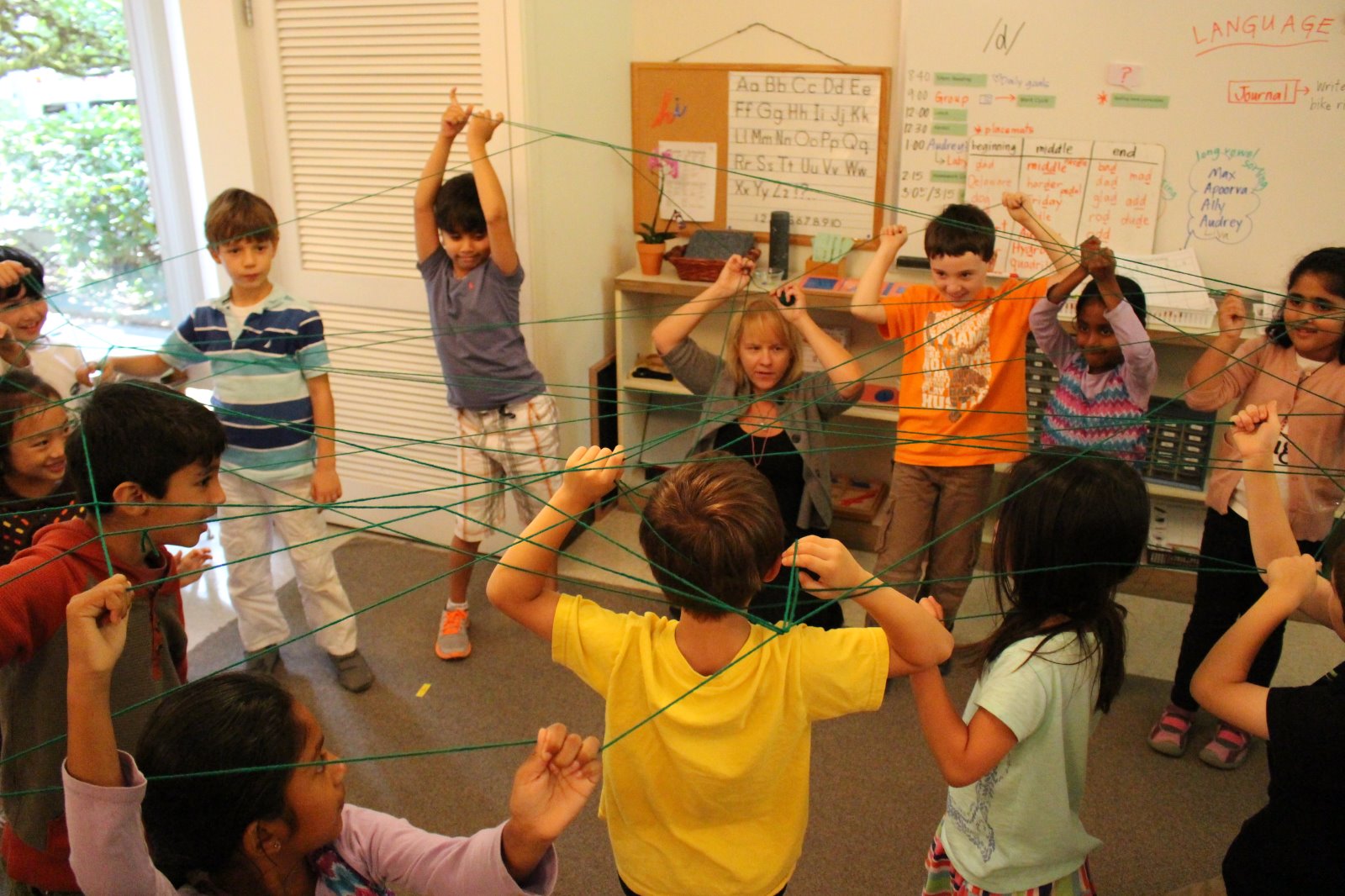
Sometimes in “sound games”, we make a chart with three columns for beginning, middle, and end placement of the sound in a word. In the past, as a primary extension, I have used a ball of yarn passed across a circle of our community to connect all these sounds together; I started and ended the circle, and at the end, we lifted and released our yarn to make a crazy shape. Currently, I ask children to offer a word with the sound in it, identify its location (beginning, middle, or end) in the word, and challenge the child to use the word with the sound in a sentence. This primary extension challenges children to understand, use, and create meaning from sounds. A secondary extension might be making a chart of their own words the following week, as a way of measuring memory of the lesson and continued application.


Maria Montessori’s phonics materials, which are often used first in 3-6 year-old classrooms, are integral to many 6-9 year-old’s confidence with both writing and the decoding process involved in reading. These materials have phonemes such as short vowels in one color (blue, to match the vowel color of the Movable Alphabet used in 3-6) with other letters in words in black. With consonant blends, the same two letters will be in red with other letters in black. 


Primary phonics card materials allow children to match vocabulary with an image card, while elementary phonics card materials allow children to decode as many as ten different words with a shared phoneme. After being introduced to the materials, children feel confident working independently or sometimes collaboratively with a peer. They read the words aloud to an adult, and sometimes they will challenge themselves in a self-selected manner in order to ingrain the vocabulary more deeply.


Word study encompasses many different functions of language, from syllabication to synonyms to rhyming words to homographs. Children study root words with prefixes, root words with suffixes, and compound words. The comprehensive Word Study Skyscraper made by Montessori Research and Development contains 5,000 matching cards, with each concept including up to ten drawers each for multiple practice. 


This Montessori material encourages children to broaden and deepen their sense of the English language, especially with the use of reference materials such as a children’s illustrated dictionary and thesaurus. Children may also challenge themselves in a self-selected manner by writing sentences or sets of words.


Finally, Montessori grammar is a beautiful endeavor in storytelling that Maria Montessori designed with her ever-present eye for detail. Each of the nine grammar symbols – noun, verb, article, adjective, adverb, pronoun, preposition, conjunction, and interjection – has its own color, shape, and story. For example, the story of the noun is about one of the biggest things on Earth – the Great Pyramid of Giza. The story of the verb follows the exciting adventures of a red sphere, which most children see (and treat!) as a ball. With the exception of the article and adjective – which, together with the noun, are introduced as the Noun Family story – each symbol has its own impressionistic key experience. A miniature environment such as a farm is often used in a Montessori 3-6 or 6-9 classroom as a physical place for children to make meaning with parts of speech.


Just as Montessori children come to recall the color coding of the bead cabinet and the stamp game, they enjoy remembering the shapes and colors of the grammar symbols, eventually coding them in written form on paper using a grammar stencil. (Again, Waseca makes a great one that is accessible for small hands.) Children get creative and have fun while learning, making connections and discoveries as they construct meaning from the world around them. 


The children featured here are reacting to eating a slice of grapefruit, as part of our Noun Family lesson. One offered this sentence: The sour grapefruit is disgusting.

Sunday, November 2, 2014

Literacy Workshop: Parts of a Mystery

In my Montessori elementary class, we study writing and reading at weekly Literacy Workshops where students participate in small-group themed activities. Recently, I shared with students a lesson called Parts of a Mystery, identifying the main characteristics of this genre:
·      A question or problem
·      Something strange or unexpected
·      A secret
·      Something missing
·      A curious detective
·      Clues and predictions
·      Distractions
·      Suspense
·      Conclusion


The Parts of a Mystery were printed on white paper with a black background, enclosed in a pouch from Out of Print, adorned with many faces of author Edgar Allen Poe. I also had a basket of magnifying loops, a raven finger puppet from Folkmanis, and a copy of Poe’s Tales of Mystery and Madness. We discussed the Parts of a Mystery, then I asked older students (in my age 6-9 class) to select two younger partners to read one of the following books:
·      The Mystery by Maxwell Eaton
·      Hermelin, the Detective Mouse by Mini Grey
·      Ginger and the Mystery Visitor by Charlotte Voake
·      The Strange Case of the Missing Sheep by Mircea Catusanu
·      Who Pushed Humpty Dumpty? And Other Notorious Nursery Tale Mysteries by David Levinthal
·      Fog Island by Tomi Ungerer
·      Quest by Aaron Becker


Each group had a grid sheet with the Parts of a Mystery on it, and each student had a different role to play:
·      Reader (oldest child),
·      Detective (usually the youngest child – who got to use the loop), and
·      Scribe (usually the middle child, if s/he was a confident writer).

After fifteen to twenty minutes, the groups had finished reading and worked on identifying the Parts of the Mystery grid sheet about the book they had read. We then returned to circle, and each group had a chance to share aloud about their Mystery. At the end of our lesson, I shared an episode of The Simpsons where the cartoon family re-enacts Poe’s poem “The Raven”. Students loved this multi-media and multi-sensory lesson, which allowed them to understand this expansive and intriguing genre of popular literature!

Tuesday, January 1, 2013

Literacy Workshops: Predicting

Reading is a crucial skill for acquiring information, developing critical thinking skills, encouraging compassion, forming logic, making choices, and navigating the unknown -- not only in school, but in the larger world, as well. Reading involves two main skills -- decoding (the ability to decipher and reproduce sounds in isolation or combination, then in word form) and comprehension. Many parents consider their child's decoding skill as the main aspect of reading ability. While phonemic awareness is very important, comprehension involves many more sophisticated abilities -- such as reading pictures for context clues, making mental images, identifying key story elements (characters, setting, plot, etc.), retelling, predicting and inferring, solving problems, relating the text to oneself or the world or other books, and demonstrating understanding through re-creations or reports.
This year, we've been working on reading skills with our weekly Literacy Workshops, which focus on decoding, comprehension, and writing or pre-writing skills related to a read-aloud text. One of our first lessons was about Choosing a "Just-Right" Book. Students in my mixed age (first through third grade) Montessori classroom generated a list of ways to know if a book is too easy or too hard (shown above). Many elementary classrooms have leveled reading libraries constructed from an adult perspective, yet I have tried to avoid this so students develop independence and knowledge about themselves as readers. (The hand drawing is a reminder from our librarian about the "five-finger" rule: if you find five words on a page that are unknown or hard to decode, that book might not be "just right" for you right now.)
One of the students' favorite Literacy Workshops was about Predicting. At the start of a school day, I placed three carefully wrapped presents of varying sizes on a rug (shown above). At morning group, I told students that these were gifts for the class which we would open at Readers Workshop later that day. I also encouraged them to touch, jiggle, hold, or carry -- but not open -- the presents, so that they might predict what was inside. That afternoon, we first discussed the definition of prediction and how we predict what will happen in the future. On a white board, I drew a graph for their predictions and the reality of the actual prize, and we noted these (shown below).
One child opened each gift. The first was a magnifying glass (for observing), the second was a game of dominoes (looking for clues or patterns), and the third was a set of the Choose Your Own Adventure series -- wildly popular during my childhood. At the beginning of each book, there is a warning, which I read aloud in an ominous tone: 

BEWARE! THIS BOOK IS DIFFERENT FROM OTHER BOOKS. YOU AND YOU ALONE ARE IN CHARGE OF WHAT HAPPENS IN THIS STORY. THERE ARE DANGERS, CHOICES, ADVENTURES, AND CONSEQUENCES. YOU MUST USE ALL OF YOUR NUMEROUS TALENTS AND MUCH OF YOUR ENORMOUS INTELLIGENCE. THE WRONG DECISION COULD END IN DISASTER – EVEN DEATH. BUT DON’T DESPAIR. AT ANYTIME, YOU CAN GO BACK AND MAKE ANOTHER CHOICE, ALTER THE PATH OF YOUR STORY, AND CHANGE ITS RESULT.

The class broke into small groups, with an older student reading to the others, who voted on what path to follow when their book asked them for direction in the plot. 
When we came together about twenty minutes later, I asked students, "How did you make your first choice? What did you predict would happen? What made you think that would happen? Were you correct? Did you go back and read the outcomes of the other choices? What was different? Which ending did you prefer?" Reflection motivates metacognition (thinking about how we think), and students enjoyed adding a gesture to their new reading comprehension skill: whenever they predict, they stroke their chins like reading detectives. In the months since this lesson, our class has revisited Predicting when reading other books, and a parent mentioned to me that her child has started using this term at home, as well. ("I predict we will have chicken for dinner!") This means she is thinking about what she is thinking all of the time -- not just during Literacy Workshop!

Sunday, May 6, 2012

Curriculum: Preposition lesson (Language)


Impressionistic lessons are intended, as Maria Montessori said, to “spark the imagination” of the child. These lessons occur across the curriculum — in cultural, math, and language studies — and involve the students in a project of understanding. A great example is this Preposition Lesson in grammar. 
Montessori symbolized the abstract by devising a series of shapes that correspond to the parts of speech. The preposition is represented by a green half-moon or bridge, as many children see it. Guides tell the Latin derivation of the word preposition (pre + ponere = to place before) and demonstrate with the farm or zoo environment where a noun would exist in relation to the “bridge”. Students come up with sentences demonstrating their animal’s use of the preposition, for example: Elephants walk over the bridge. Green nomenclature cards label the preposition over and the noun elephants. Students work independently or with partners to create language within the context of an environment. 
Extensions in the classroom involve the guide asking the child: “Where is the elephant walking?” The student may respond: “The elephant is walking over the bridge. Over is a preposition.” Levels of sophistication include: labeling, reading aloud, using self-correcting card materials in the grammar drawers for reinforcement, writing the words, and using the words in proper context through sentence formation.