Showing posts with label independence. Show all posts

Tuesday, December 31, 2019

What the Hand Does, the Mind Remembers


“What the hand does, the mind remembers.” – Dr. Maria Montessori


Children remind me that they learn with their hands, something Dr. Montessori understood through quiet observation over a century ago. This continues to be true in the current time of digital technology (literally: tools used by the hands) and an adult focus on abstraction as a metric of success. I have grappled with the inclusion of technology and testing in the Montessori classroom, in both private and public charter environments, and I continue to believe that they are incongruous with the beautiful and patient process of a child learning by holding actual objects – clay, fossils, fern fronds – with their hands.

“Do not tell them how to do it. Show them how to do it and do not say a word. If you tell them, they will watch your lips move. If you show them, they will want to do it themselves.” – Dr. Maria Montessori

A few years ago, I asked a mother of one of my students to come in and demonstrate how she makes her own kombucha. There were simple ingredients and a live bacteria, which we stored in our room for weeks and watched grow, documenting its bubbling surface and the layers that it formed in a controlled environment. It is much easier to just buy a bottle of kombucha at a store, however the children looked forward to being a part of the process – using gloves to touch the SCOBY, selecting the flavors to add. Convenience is not always possible nor preferable. It often stalls understanding.

"The senses, being explorers of the world, open the way to knowledge." – Dr. Maria Montessori


In the Montessori learning environment, especially the expansive Cosmic Curriculum, there are many varieties of concrete materials – from the wooden Bohr diagram modeling the inside of an atom to the Timeline of Life with era boxes full of fossils to the Land and Water forms (used with colored water poured from a jug). Many of these initial materials have extensions which allow interested children to go deeper. For example, many children choose to make their own Land and Water booklet with brown and blue paper, or (in this case, shown above) models formed by painting dried clay models.

When I think about the ways in which public education (and, often, adult thinking in general) prioritizes large quantities of superficial, one-time-only lessons – some of which are never reviewed nor returned to – I feel thankful that Montessori education functions in the exact opposite manner. Children are encouraged to go deeper, to be reiterative, to be creative with a concept, making the trench of the neural pathways surrounding it that much further ingrained.

“Education is a natural process carried out by the child and is not acquired by listening to words but by experiences in the environment.” – Dr. Maria Montessori


Children learn about Parts and Kinds in Montessori education, from math to language to science:

Parts of the Atom and Kinds of Atoms

Parts of a Line and Kinds of Lines

Parts of Speech and Kinds of Words

Children are attracted to the largest things and the smallest things. When we study the Coming of the Earth, we find an inter-relatedness with the Inner Earth and the Plate Tectonic activity that caused and causes land forms to exist, that allowed animal and eventually human migration to occur. Children are fascinated by superlatives: the highest, the furthest, the smallest, the coldest, the hottest. Again, it would be easier to simply purchase a model of a volcano from a craft store. However, witness these children forming volcanoes with their own hands!

“The hands are the instruments of man’s intelligence.” – Dr. Maria Montessori


It is amazing to be alive, and children in Lower Elementary also come to a knowledge that death is something that belongs to all things. We study life cycles of living things, such as a tree or a jellyfish, and we also know where our Universe is in its own lifespan. (Like me, it’s middle-aged!) This knowledge of the ephemeral quality of nature is deepened when children see the Timeline of Life, specifically how old the world is, how old other organisms are (like the jellyfish, one of the longest lived creatures on the planet), and how young we humans are as a species. When we study the life cycle, we see the same phases and know that each organism is unique and special.

“The human hand allows the mind to reveal itself.” – Dr. Maria Montessori


One of the most inspiring things to see is what children create from their own imaginations. When they use geometric building blocks as a Practical Life activity, they are resting their reading mind and engaging their body – their kinesthetic and tactile intelligences. They are using the concept of gravity when they balance an arch on a cone. They are using the concept of symmetry when they build a structure out of rectangular prisms, pyramids, and cylinders. Mainly, though, they are free to experiment, make mistakes, try again, and eventually hopefully innovate while creating an architecture of their own happiness.

Friday, April 14, 2017

Montessori Language Materials: Intuitive and Inspiring!


Maria Montessori created self-correcting card materials for children to use independently to understand the function of sounds (phonics), the meaning of words (vocabulary and word study), and the function of words (mechanics, grammar, and sentence analysis). What is amazing is that she did this in Italian over a century ago, and the Montessori method of presenting language concepts works beautifully in all cultures around the world where it is presented.


For this blog post, I will focus on phonics, word study, and grammar. A buzzword in education for the past twenty years or so has been “phonemic awareness”, the ability to hear, isolate, blend, and replicate sounds and sound combinations. Since one of the tenets of Montessori education is the presentation of concepts in their most concrete form, phonics are presented as “the building blocks of language”. 


For the past several years – both at the private Montessori school where I previously worked and in my current Montessori-hybrid charter environment – I have had great success with weekly “sound games” which introduce the concepts which are also present in Montessori language materials, such as the amazing collection of phonics drawers made by Waseca. This material is also consistent with the Orton-Gillingham method in its application for children with dyslexia, which often occurs undiagnosed at the 6-9 age, and is also helpful for children of all abilities.


What is a “sound game”? I have introduced this lesson mainly as a brainstorming session with students about the sounds we hear, the tongue placements and breathing associated with sounds, and whether we consider those sounds vowels or consonants. As children, most current adults did not learn how to be “phonemically aware”; instead, we simple memorized which letters were vowels and which were consonants. Unfortunately, we were taught incorrectly. 

Vowels and consonants are sounds; letters are pictographs associated with sounds. The word “vowel” is Latin for “vocalize”, and the word “consonant” is Latin for “with sound”. This is why vowels are sounds made with an open mouth, and consonants are sounds which involve an ejection of air or vibration. Along with tongue placement (which is most notably used in speech therapy), Montessori children understand by touch, visual input, and sound what kind of phoneme they are making or hearing.


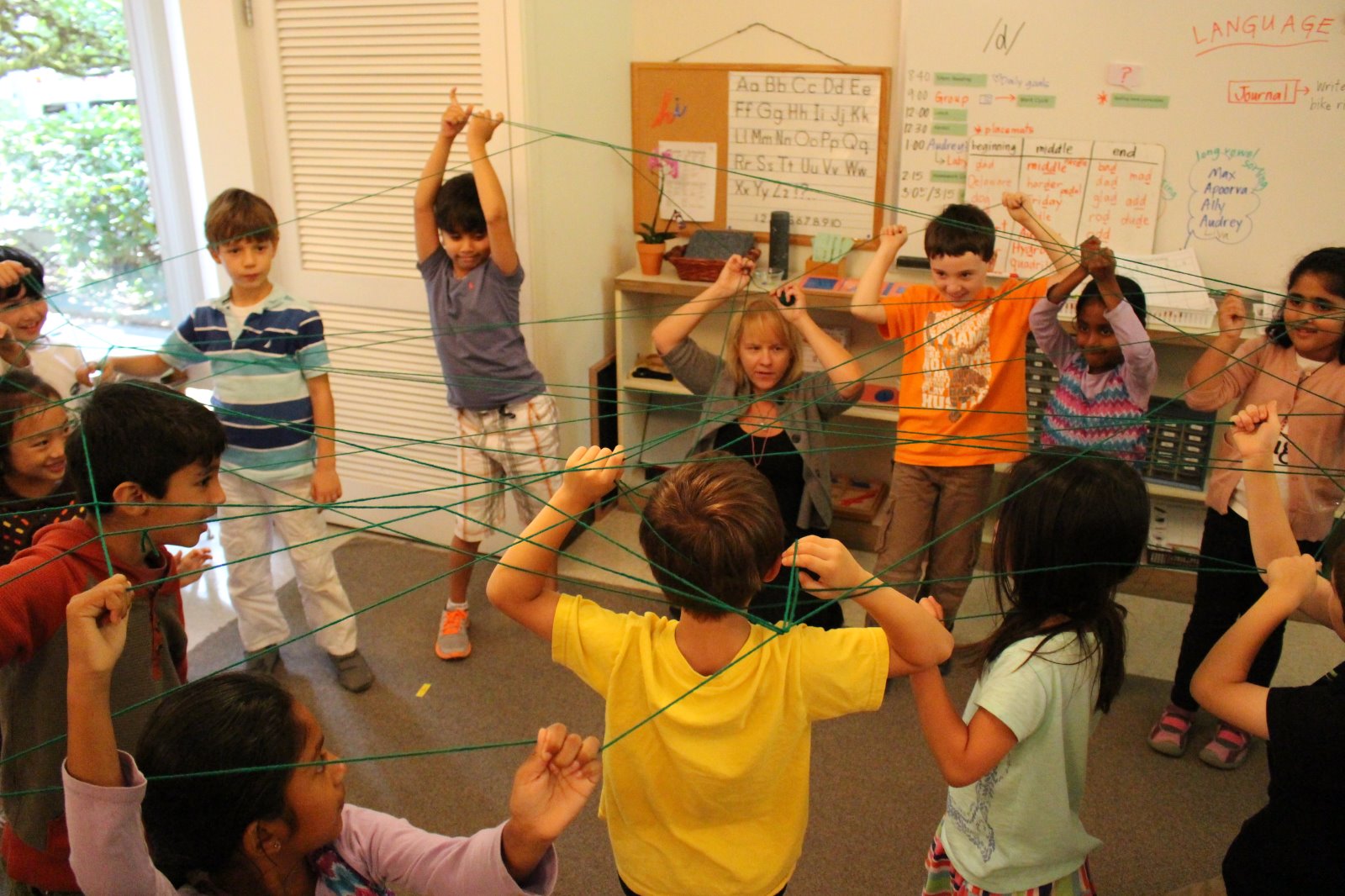
Sometimes in “sound games”, we make a chart with three columns for beginning, middle, and end placement of the sound in a word. In the past, as a primary extension, I have used a ball of yarn passed across a circle of our community to connect all these sounds together; I started and ended the circle, and at the end, we lifted and released our yarn to make a crazy shape. Currently, I ask children to offer a word with the sound in it, identify its location (beginning, middle, or end) in the word, and challenge the child to use the word with the sound in a sentence. This primary extension challenges children to understand, use, and create meaning from sounds. A secondary extension might be making a chart of their own words the following week, as a way of measuring memory of the lesson and continued application.


Maria Montessori’s phonics materials, which are often used first in 3-6 year-old classrooms, are integral to many 6-9 year-old’s confidence with both writing and the decoding process involved in reading. These materials have phonemes such as short vowels in one color (blue, to match the vowel color of the Movable Alphabet used in 3-6) with other letters in words in black. With consonant blends, the same two letters will be in red with other letters in black. 


Primary phonics card materials allow children to match vocabulary with an image card, while elementary phonics card materials allow children to decode as many as ten different words with a shared phoneme. After being introduced to the materials, children feel confident working independently or sometimes collaboratively with a peer. They read the words aloud to an adult, and sometimes they will challenge themselves in a self-selected manner in order to ingrain the vocabulary more deeply.


Word study encompasses many different functions of language, from syllabication to synonyms to rhyming words to homographs. Children study root words with prefixes, root words with suffixes, and compound words. The comprehensive Word Study Skyscraper made by Montessori Research and Development contains 5,000 matching cards, with each concept including up to ten drawers each for multiple practice. 


This Montessori material encourages children to broaden and deepen their sense of the English language, especially with the use of reference materials such as a children’s illustrated dictionary and thesaurus. Children may also challenge themselves in a self-selected manner by writing sentences or sets of words.


Finally, Montessori grammar is a beautiful endeavor in storytelling that Maria Montessori designed with her ever-present eye for detail. Each of the nine grammar symbols – noun, verb, article, adjective, adverb, pronoun, preposition, conjunction, and interjection – has its own color, shape, and story. For example, the story of the noun is about one of the biggest things on Earth – the Great Pyramid of Giza. The story of the verb follows the exciting adventures of a red sphere, which most children see (and treat!) as a ball. With the exception of the article and adjective – which, together with the noun, are introduced as the Noun Family story – each symbol has its own impressionistic key experience. A miniature environment such as a farm is often used in a Montessori 3-6 or 6-9 classroom as a physical place for children to make meaning with parts of speech.


Just as Montessori children come to recall the color coding of the bead cabinet and the stamp game, they enjoy remembering the shapes and colors of the grammar symbols, eventually coding them in written form on paper using a grammar stencil. (Again, Waseca makes a great one that is accessible for small hands.) Children get creative and have fun while learning, making connections and discoveries as they construct meaning from the world around them. 


The children featured here are reacting to eating a slice of grapefruit, as part of our Noun Family lesson. One offered this sentence: The sour grapefruit is disgusting.

Friday, May 6, 2016

Vitamin N

Recently, Richard Louv has written some of the most important books for parents and educators about the link between self-regulation, happiness, and success (in a holistic sense) and nature for children: Last Child in the Woods -- Saving Our Children from Nature Deficit Disorder, The Nature Principle, and his newest (released in April 2016) Vitamin N. Vitamin N is Nature, the ingredient so crucial for children to become competent, independent, and self-realized beings by integrating their physical, spiritual, emotional, and social needs in an environment where they are free of interference from adults.


I cherish and feel grateful for the existence of a natural space not one mile from our school where my students and I venture several times per year -- at least once per season -- to develop Vitamin N and nurture our spirits. We do this through free play in the forest environment, constructing (and often deconstructing) a fort made from a fallen tree. In this same area, past classes of mine have also learned about the necessity of the canopy -- the mixed age trees which mirror the mixed-age Montessori classroom -- for the survival of all biological life in the woods. Like the forest, we need all of our skills and difficulties in order to be the dynamic class that we are.


Each child receives her own tree under which she can see the world existing in its own rhythm and growing at its own pace, just as children do.


Students take their journals to a space that belongs only to one child at a time -- the nearest being ten to twenty feet away -- and soak in the environment through writing and art, sometimes using dirt or leaves to color their drawings. They write about what comes to mind about the natural world, and how the world entered their senses.


They touch nature, and by doing so, they return to themselves. This is what Maria Montessori envisioned with her Erdkinder program, and it is also how we maintain an authentic and impactful Montessori education. Louv cites Martha Farrell Erickson -- developmental psychologist and author of Together in Nature: Shared Nature Experience as a Pathway to Strong Family Bonds -- who advises parents and children to unplug from technology to create "an opportunity for ... affective sharing" to impact a child's lifelong development. Children need nature and a nurturing connection to their loved ones more than they need social isolation via electronic devices.

Here is a brief sampling of ideas for how to increase your child's intake of Vitamin N (Nature):
  • Put nature on the calendar -- just as you would schedule vacations or sporting events.
  • Think of nature as enrichment time -- not just after school classes, music lessons, and summer camp.
  • Turn your commute into a nature safari -- play I Spy with cloud formations, trees, and wildlife. Read signposts for land, water, and sky. Better yet, walk to school once per week, if you live close enough.
  • Play hooky -- take a day off work and let your teacher know you and your child will spend the day in the natural world re-connecting. Your child might take photos to share with classmates upon her return!
  • Stash a G.O. (Go Outside) bag in your car -- with compass, binoculars, water bottle, and hiking shoes -- so your family can be spontaneous and Go Outside at a moment's notice.
  • Recognize that boredom isn't a negative -- a child remembers best the unexpected adventure of the natural world.
  • Be the guide on the side -- ask questions of your child to elicit her logic and imagination, and resist the adult desire to control by answering these questions. This empowers your child and models curiosity over expertise.
  • Stay up late on Friday and Saturday night, and study the constellations. Your child may already know the ancient stories in the stars.
  • Paint with mud or leaves.
  • Press flowers between the pages of a heavy coffee table book you rarely open, using wax paper to protect your book.
  • Build a rock cairn.
  • Let kids take appropriate risks (walking on logs, for example) to build confidence, gross motor control, and resilience.

Sunday, November 18, 2012

Honoring the Emotional Aspect of the 6-9 Child

Montessori education addresses the whole child, giving equal respect to a child's intellectual, emotional, social, physical, and spiritual needs. Many educational models focus mainly on the intellectual with lesser regard for the feelings, interactions, movements, and insights of students. One of the greatest gifts Montessori parents bestow on their children is honoring the emotional life of their child, letting him/her grow at an individual pace according to his/her strengths and areas of development. Parents and teachers may benefit from remembering Maria Montessori's belief that "it is the child who makes the man, and no man exists who was not made by the child he once was." It is our responsibility as adults to provide structures of routine and consistency, and it is imperative that we also step out of the child's way to allow for his/her own experiences.
Emotionally, the 6-9 child is becoming more independent than s/he was just last year, perhaps demonstrating rebellion against or resentment for what seems like default authority and assumed fact.  As Montessori said, "if an educational act is to be efficacious, it will be one which tends to help toward the complete unfolding of life. To be thus helpful it is necessary rigorously to avoid the arrest of spontaneous movements and the imposition of arbitrary tasks." This might fall under the category of a parent or teacher replying, "because I said so," a statement that children find (understandably) illogical. While the 6-9 child is socially very concerned with justice, emotionally s/he is simultaneously pushing at imposed limits and at times acting "out of character", though what s/he is really doing is developing character by striving toward individualism. 
While the 6-9 child is often concerned socially with belonging, emotionally s/he is chiefly concerned with personal happiness. In the Montessori classroom, social responsibility and emotional peace are balanced by daily, spontaneous problem-solving. The adult serves the child best by helping when needed and asking the child to "find a peaceful solution" or to accept that which s/he cannot change. This is a life skill that many adults still find challenging, yet children are frequently willing to discover a way of their own to make a situation feel better. This demonstrates the familiar declaration of the Montessori child: "I can do it myself," a kind reminder to adults not to intervene unless necessary.
An orderly environment has an emotional impact of great significance on the 6-9 child, who is branching out into a world that can feel scary and chaotic. The Montessori classroom is tailored to the height and viewpoint of a child, not to that of the adult. Work is arranged on low shelves sequentially, with care for beauty and space, so that a child can freely choose materials and use them (after a lesson with a teacher) without further need of an adult. S/he may also repeatedly use the work to encode learning and extend enjoyment, which has a direct impact on his/her happiness. The child feels empowered, free, and successful in the classroom, at times one of the few places in his/her world where s/he is truly trusted. Materials are self-correcting teachers of the child, who uses his/her hands to create understanding within the prepared Montessori environment. As Montessori said, "The children must be able to express themselves and thus reveal those needs and attitudes which would otherwise remain hidden or repressed in an environment that did not permit them to act spontaneously." The Montessori classroom is the child's work space, at all times accessible. 
The 6-9 child is pushing away from family a bit by meeting new people who have different skin colors, beliefs, and behaviors rather than more familiar characteristics. Montessori education values differences as well as similarities, as every child has his/her own personality, learning style, and confidence level. Children learn to look for comparisons between themselves, and Montessori guides encourage positive self-talk, a sense of striving for one's personal best, acceptance of emotions, and helpfulness within the classroom community. It can be a painful time for parents to pull back and allow your child to let go of your hand in order to strengthen his/her own sense of self. At school and at home, consistency and routine are vital to a child’s sense of stability. 
Solid partnerships in the two most important locations of your child’s life make him/her feel secure.  Montessori suggests that "an adult, if he is to provide proper guidance, must always be calm and act slowly so that the child who is watching him can clearly see his actions in all their particulars." Children absorb so much that we do not, having become with age and experience accustomed to our own posture, tone of voice, and volume. Teachers and parents model the behavior they wish to encourage in the child. When adults see a child suffering, we feel an inherent desire to either comfort or control the situation, perhaps recalling the way the child as a baby screamed in the supermarket. We were embarrassed or inconvenienced, but that child is no longer a baby. Truly respecting the 6-9 child involves asking what s/he needs at the time, rather than assuming or jumping instinctually to conclusions. 
Montessori understood that this requires mindfulness and restraint, since for adults "even to help can be a source of pride." We adults feel important when we help children, but children need to feel important by having a voice and a choice in their emotional lives. Often, when given a chance to reflect on his/her emotions, the 6-9 child will find a way to handle a situation that feels appropriate to him/her: taking some time to calm down, eating a snack (to balance blood sugar levels) or drinking water, practicing yoga in the peace corner, or journaling about a problem. Often children verbalize or demonstrate solutions that prove best to themselves, since each person knows best him/herself.
Maria Montessori implored guides trained in her method to avoid making demands of children and to instead use positive language -- telling what one wants rather than telling what one doesn't -- to model problem-solving and encourage emotional strength through words and non-violence. It is interesting, nonetheless, that Montessori admonished adults in two of her most famous sayings regarding students' emotional development: "Never help a child with a task at which he feels he can succeed," and "Do not erase the designs the child makes in the soft wax of his inner life." Montessori students are impressionable people who are learning -- from us, the adults in their lives -- how to balance emotions and express their feelings. Children need to see that adults are not perfect, that we make mistakes, that we feel regret, that we practice courage by apologizing, that we help other people, and that we strive for our own personal best.

Honoring the Social Aspect of the 6-9 Child

Maria Montessori defined planes of development that distinguished the kindergartner from the elementary school-aged child. A main difference was social. Beginning in first grade, a child gradually pulls away from family and toward peers. This shift makes consistency at home and school crucial, since the child is experimenting with cause and effect, rules and consequences, and fairness and justice (which may not always be synonymous) in the two major arenas of his/her life. In the Montessori classroom, the child experiences respect, freedom, and responsibility both to self and to the learning environment comprised of materials, lessons, and classmates of various ages and abilities. 
Socially, the 6-9 child is passionate about justice. At this age, children create mini-societies, microcosms where they can role-play power, status, and competition and feel effects immediately. Our school year begins with a rules assembly, where the societal framework of the Constitution is placed alongside the faculty’s commitment to a mission statement honoring the whole child. School rules are a child’s version of the same expectations for behavior upheld in the larger society, explained with examples and reason. These rules are: respect the rights and needs of others, act in a safe and healthy way, treat all property with respect, and take responsibility for learning. 
Students often discuss at group the logic of these rules, imagine hypothetical (“what if…?”) situations, and work with partners to illustrate them using their hands, hearts, and minds. It is very important that the child understands for him/herself the values of the community, which mainly concern respect, responsibility, and safety. Friendships and belonging are significant at any age, and at the 6-9 level friends can quickly become foes when carefully crafted rules are bent or leaders assert themselves without being chosen. Montessori classrooms are proactive in their approach to social dynamics. Teachers follow the child and respond to needs as they arise. 
We use positive language, exercises in grace and courtesy, peace education, class meetings, and mediation. Conflict resolution is a daily endeavor in all classrooms. Teachers are available to students as guides and models for peace-making, yet the Montessori teacher is not a judge in matters of dispute. We hear concerns and remind children of their own abilities: to tell others how they feel and what they want, to understand the meaning of actions, to ask others about their intentions, and sometimes to apologize and make reparations for the future. Listening skills, the ability to take turns, and a sense of perspective in a consistent three-year cycle bring amazing insights to the 9-year-olds who leave our classes mature and caring individuals.
The 6-9 child enjoys such democratic processes while also exploring morality to understand for him/herself what seems good and what seems evil, and why. The Cosmic Curriculum, the center of study at this age, describes physical and chemical processes that occur without consideration to feeling – such as extinctions, eruptions, and tectonic shifts. Children relate to these events on a very personal level, often mimicking the sounds of a volcano just as, on a stormy day, their moods often create weather within which is similar to that outside. The child also notices in the actions of his/her peers that everyone – even a teacher, even a parent – makes mistakes and is vulnerable to emotions, stress, and fatigue. Honesty about one’s feelings, a sense of humor, and humility go a long way in the Montessori 6-9 classroom, and students benefit from sharing groups where they can compliment others on their perseverance, personality, and progress.
Finally, Montessori classrooms honor the child by allowing him/her to select the preferred social context for activities – solo, partner, or group work.  Each dynamic’s success depends in large part on the individual’s learning needs.  The mixed-age classroom aids a child’s social development by allowing for opportunities to learn from others’ actions, to model social responsibility, and to respond to others’ needs. It creates an atmosphere where children learn to help and be helped by others. Children gain an appreciation for their own work as well as others’ accomplishments, which challenge them without involving a sense of competition. Older children learn patience and tolerance by serving as role models and reinforcing previously learned concepts. Younger students learn courtesy, manners, and conflict resolution from older peers. By staying in a classroom for a three-year period, children develop a strong sense of community and stability, with one-half to two-thirds of a class returning every year. 
As Maria Montessori said, "When we think about mixed ages... we should not have a supermarket, but just what is essential." Because social dynamics are new each year, depth of study occurs when revisiting familiar lessons at a more sophisticated level of comprehension with a new role as an experienced learner. Familiarity and belonging also allows a teacher to better understand each child’s learning style, set holistic learning goals, build on strengths and weaknesses, and foster meaningful relationships with students and their families. It’s amazing to watch students who started as 3-year-olds move through the elementary years with a web of relationships that cross ages, cultures, and learning styles.  

Monday, May 7, 2012

Parent Involvement in Montessori Classrooms

Sometimes, parents wonder how they can be involved when their child attends a Montessori school, or any school for that matter. The truth is, any teacher loves to have parent support in the classroom, especially when the parent asks the teacher questions about how to do so. I have been fortunate to have parents whose schedules often allow them to participate as field trip drivers and chaperones, to volunteer to give weekly spelling tests or listen to students read, or to come into class to share an experience or special interest. 
One of the most important yearly events that students share with their classmates is their birthday celebration. A candle at the center of group represents the sun, and a globe represent the Earth. In the Montessori 3-6 classroom, many students sang a song as the birthday child carried the globe around the candle: "The Earth goes around the sun/ The sun/ The Earth goes around the sun/ It takes 12 months/ One year/ 365 days." In Montessori 6-9 classrooms, there are many variations. In my class, the child and his/her parents share photos and stories from each year of a child's life, and at the end of the group, the other students ask questions and sing "Happy Birthday". The birthday boy or girl often chooses to donate a new or used book to the classroom library, as his/her gift to the community.
Another opportunity for parents is to join their child for a healthy lunch and talk with his/her classmates.
At other times, parents offer to share about their profession (such as a mom who is a nurse) or a hobby, such as a dad sharing about a family's recent beehive operation. When their child participates as a "co-presenter", s/he feels a great deal of pride and leadership.
Parent volunteers in the classroom are so important, especially those who give spelling tests to students or listen to them read one-on-one. Parents learn how to listen for decoding and ask questions that aid reading comprehension. They also provide an extra set of eyes for observation of student assessment in reading, which is very valuable.