Showing posts with label the whole child. Show all posts

Wednesday, December 19, 2018

The Prepared Environment

“To assist a child we must provide him with an environment which will enable him to develop freely.” – Maria Montessori

One of the most unique aspects of a Montessori learning environment which sets it completely apart from other classrooms is the preparation and sequencing of the materials which Maria Montessori created over a century ago with the children whom she guided. Since her death in 1952, Montessori guides (teachers) have continued using Montessori materials and creating materials inspired by her scientific approach. In her books, Montessori speaks so often about the importance of the prepared environment where child can cultivate confidence, independence, and mastery.


“The environment itself will teach the child, if every error he makes is manifest to him, without the intervention of a parent or teacher, who should remain a quiet observer of all that happens.” – Maria Montessori

Usually, shelves in the Lower Elementary room are arranged by curricular area – Language, Math, Practical Life, and Cultural studies. Guides rotate the shelves throughout a school year, due in large part to the observations of the children by the adult guide. She notices which materials are relevant and enticing to the children, and she also observes when the children are no longer intrigued. When new materials appear, interest is stirred and activity is contagious amongst the children, who want to manipulate the concrete materials with their hands and other senses.

“The environment must be a living one, directed by a higher intelligence, arranged by an adult who is prepared for his mission.” – Maria Montessori


The center of the 6-9 year old mixed-age classroom is Cosmic Education, the scope and order of the stories of the Universe from largest and oldest to the most recent and familiar. The vastness of the Cosmic curriculum in particular – from astronomy, physics, and chemistry to geology, geography, and life sciences – demands fluidity of movement as the children move through the Great Lessons. The children’s best and first teacher is the real material which they are given to touch, such as real plants in need of water, real fossils of trilobites, and real igneous rock that was once ejected from a real volcano.

“The child must live in an environment of beauty.” – Maria Montessori


Regular change on the Cultural shelves mimics the inevitable and continuous changes on Earth – from the growth of continental plates from vulcanism to the erosion of rock through the Work of Wind and the Work of Water to the migration of humans due to natural hazards and civilization. These grand ideas are presented as key experiences to spark the imagination of the child.

“To do well, it is necessary to aim at giving the elementary age child an idea of all fields of study, not in precise detail, but an impression. The idea is to sow the seeds of knowledge at this age, when a sort of sensitive period for the imagination exists.” – Maria Montessori

Math shelves contain materials which the child can use independently or with a partner after an initial lesson from an adult Montessori guide. The materials are also sequential and attuned to different learning styles. For example, several different materials can be used by a child learning a math operation, such as addition. The Golden Beads are all the same color and require the child to use her pincer grip, which is developing at the 6-9 ages, with great care and precision. The Stamp Game is similar to the Golden Beads in terms of quantity and place value concepts, yet variations include size, shape, and color (also reinforcing place value – green representing units, blue representing tens, and red representing hundreds).

“The first aim of the prepared environment is, as far as it is possible, to render the growing child independent of the adult.” – Maria Montessori


The Small and Large Bead Frames are often an option preferred by children with strong spatial and kinesthetic learning styles, especially those who have tired of using the Stamp Game in a plane; the Bead Frames allow exchanging to happen in the vertical sphere. The Bank Game allows children to work together in small groups, role-playing using the expanded form of the operations. In most Montessori classes, the children eventually (and ideally) work with such confidence and independence that they hardly register the observing presence of their adult guide.

“The teacher’s first duty is to watch over the environment, and this takes precedence over all the rest.  Its influence is indirect, but unless it is well done there will be no effective and permanent results of any kind; physical, intellectual or spiritual.” – Maria Montessori

Language shelves contain materials (usually card materials) which are self-correcting and self-explanatory for a child to use – again, after an initial lesson with an adult Montessori guide, by herself or with a partner. Children learn sounds of vowels and consonants using Phonics towers, language relationships (such as compound words, synonyms, and homophones) using Word Study drawers, and parts of speech (such as nouns, adjectives, and prepositions) using Grammar boxes.

“Not upon the ability of the teacher does education rest, but upon the didactic system.  When the control and correction of errors is yielded to the materials, there remains for the teacher nothing but to observe.” – Maria Montessori


Children keep track of the drawers they complete in order to find appropriate partners of any age, and many children enjoy the maturity and responsibility of giving lessons to their peers. The adult guide watches and intervenes only when needed, redirecting the child back to the material and using questions to assist in the child’s own discovery. Children help each other in the same way as the adult models them, avoiding telling an answer and instead asking questions or walking through the prepared environment to locate resources such as a dictionary, atlas, or thesaurus.

“Education is a natural process carried out by the human individual, and is acquired not by listening to words, but by experiences in the environment.” – Maria Montessori

Practical Life is an area of the Montessori curriculum which is central to the 3-6 year-old Primary classroom, however since Lower Elementary children ages 6-9 are also still developing fine motor, gross motor, sensory integration, and self-regulation skills, the activities and materials on the Practical Life shelves provide great relief and reprieve for children from the abundant (and sometimes rigorous) academic materials.

“The exercises of practical life are formative activities, a work of adaptation to the environment. Such adaptation to the environment and efficient functioning therein is the very essence of a useful education.” – Maria Montessori


Practical Life materials are hands-on – such as braiding, sorting, and weaving. Practical Life materials are creative – such as watercolors, clay tablets, and building blocks. Practical Life materials soothe and calm the whole body – such as yoga, jumping rope, and carrying hand weights. These shelves are favorites for children in need of a “brain break” who often return to their intellectual work soon after with renewed energy and concentration.

“The materials, in fact, do not offer to the child the content of the mind, but the order for that content.” – Maria Montessori

One of the most iconic places in any Montessori learning environment is the Peace Table, a beautiful space where children may sit by themselves or with a friend with whom they have conflict. In a Primary room, a single rose in a vase on a table symbolizes Peace. In my Lower Elementary classroom, I have decorated our Peace Table (which sits close to the floor) with a soft scarf, a Tibetan singing bowl, a Chinese meditation egg, and a few lovely gemstones. Maria Montessori respected children as emotional, intellectual, social beings. The adult guide may give a lesson on how to use the Peace Table – either for internal balance or for interpersonal problem-solving – yet it remains in the child’s power to decide if and when to use the materials.


“The children must be free to choose their own occupations, just as they must never be interrupted in their spontaneous activity.” – Maria Montessori

The scope and sequence of the Montessori curriculum and classroom set-up is quite intentional, not unlike the scaffolding of a building under construction – or a theater stage. Children are unaware of the preparation of their learning environment – from lessons to materials to shelf layout and rotation. They do not need to know all the content or all the steps in order to grow. They only need to feel secure that they are free to explore and discover in an organized fashion.

“Freedom without organization is useless.  The organization of the work, therefore, is the cornerstone of this new structure.  But even that organization would be in vain without the liberty to make use of it.” – Maria Montessori

Sunday, August 11, 2013

The Middle Path of Montessori


As a Montessori teacher, I have for years heard two presumptions about this educational method from those who know a little about it, but not a lot: "Montessori is really structured, isn't it?" and "Montessori? That's not very structured, right? Kids just get to do whatever." These dualistic opinions have often puzzled me, and it is only after reading a great book called The Genius in Every Child: Encouraging Character, Curiosity, and Creativity in Children by Rick Ackerly, that I finally have come to understand why people -- usually, parents with children new to Montessori -- think one way or the other. Ackerly -- although not a Montessorian -- writes from the perspective of a longtime educator and father about his experiences with students, their parents, and his own children in a way that resonates with the Montessori approach. He makes a key distinction between guiding students and leading them, the former being superior to the latter. His writing is very succinct, humorous, and insightful about the ways in which education can develop the "genius" alive in each student by encouraging responsibility, honoring uniqueness, caring for the "whole child", and engaging the will rather than expecting mastery. 
1. Responsibility. Ackerly adeptly shares anecdotes which illustrate his evolving understanding of a life's work in education. One of the key points he makes is that children need to be trusted with responsibility. Parents and teachers, he cautions, "can take that enthusiasm for learning away from them if (a) we care more about it than they do, (b) we get worried about their success, (c) we make them give up play (which is a child's right), and (d) if we turn their parents into teachers" (6). One of the main tenets of Montessori education is the presentation of a carefully prepared environment (of both hands-on materials and curriculum in the form of key lessons) that encourages and supports what Maria Montessori called "auto-education". She believed that children have within them the will to pursue their own development, to ask questions, and to challenge the boundaries of reality. This is in stark contrast to the ideology of John Dewey, the father of contemporary public education, whose approach was modeled on the assembly line in the early days of the Industrial Age. That is not the world we live in now, and Maria Montessori had the foresight over a century ago to see children as they were and to help them develop as human beings in relation to the world. Students show their interests, teachers give them lessons on math concepts or parts or speech or kingdoms of life, and the community of learners go as deeply into their studies as they wish.
Ackerly clarifies the term "genius" in his book as "the teacher within... the you that is becoming" (ix).  "Another manifestation of genius is character, and ... to the Greeks kharakter was the imprint that the gods put on the soul at birth. Educating is creating conditions in which the character that is your child becomes what he or she is supposed to become" (38). This reminds me of the aphorism at my school, which hangs above the entrance: "I am becoming..." The verb tense of that statement underlines that the present moment -- not the past, not the unknown future -- is the source of character, curiosity, and creativity in the learner. Another tenet of Montessori education is that it takes place within a mixed-age three-year cycle, whereby two-thirds of the class returns each fall and younger students work with older mentors to understand their environment and studies. Some people ask about the role of the teacher in a 1st through 3rd grade classroom, and it is one of the main reasons that I enjoy my work so much. The teacher (or, as Montessori called her, "guide") is as active as necessary and as invisible as possible. An effective Montessorian observes the children -- not only their intellectual pursuits, but their physical habits, their interactions with one another, their wonder at nature and beauty, and the ways in which they react emotionally throughout the day. Montessori teachers walk a fine line, being careful not to interrupt a child in a state of flow and asking questions only when a need arises. Ackerly strongly suggests that parents honor their role in their child's life with the reminder that "children need teachers at school and parents at home" (7). He comments on the trend of "helicopter parenting": "Hovering is perhaps normal these days, but it often unknowingly stifles, inhibits, and in many ways is counterproductive to the discovery and development of a child's genius" (13). 
Ackerly also addresses the subject of responsibility in terms of a child's social behavior. In the past ten years, I have had many different kinds of interactions with parents, most of them very supportive and understanding. Parents want their child to succeed, of course, and sometimes this becomes an extreme desire to prevent anything bad from ever happening to their child. Sometimes, parents take on their child's social or emotional issues and project hostility toward a teacher. Ackerly, himself an educator and a father, reminds parents: "If you care more about it than they do, you absolve them of responsibility... Support them in the lifelong challenge of harmonizing their needs, drives, and interests with those of others" (34). Far from sparing a child from growing emotionally through a struggle, he states that in educating a child's character, "Nothing succeeds like taking responsibility. Nothing succeeds like failure. Failure is at least as powerful an educator as success" (48). If a parent reacts with anxiety and anger when the child experiences a challenge, the child learns that s/he is not trusted to handle his/her emotions and social interactions. The parent behaves as if the child is in constant need of saving. The best parent-teacher-student relationships I have experienced over the years have consisted of respectful communication between the adults about the child's learning life. Ackerly advises that "our children need to be noticed more and analyzed less, delighted in more than worried over, challenged more than protected, not so much made to be good as taught to be good at being themselves (40). One of my favorite suggestions is to "act as if you are the variable (and your child and everyone else are the constant)." Complaining or blaming are less useful than taking responsibility for oneself and becoming comfortable with adapting to the many aspects of life we cannot control.
2. Uniqueness and the Whole Child. Many contemporary educational models claim to be "holistic" in their interdisciplinary approaches. Montessori education values a rich and wide array of academics and extends its "holistic" approach to place intellectual development on the same level of importance as a child's emotional, social, spiritual, and physical development. Ackerly echoes this belief when he writes that "everything a child does occurs in an intellectual, social, emotional, and spiritual context... the primary determinant of how and what the child learns" (23). Of course, school is a place to learn -- just not simply about history, chemistry, phonics, and fractions. School is a place to learn about oneself and others -- other people, other places, and other ideas. When a child is learning, s/he enters a wonderful state where s/he is intimate with study and peaceful in his/her curiosity about it. That moment is crucial and should not be interrupted, even by an adult's admiration -- which Maria Montessori cautioned her guides to restrain. Ackery agrees: "When your child shows you a piece of work, it is undisciplined to say: 'My, how smart you are.' Much better for us to think of something new like: 'Oh, good, I can see you have been practicing,' or 'Did you work hard on it?'" (30). In my class, I strive to use value-less language or to ask questions, rather than to give approval or disapproval, because the child's work belongs to him/her and is special. It should have nothing to do with anyone else's opinion, which can easily influence children's self-esteem. 
Ackerly calls this curious and engaged state of learning "greatness (which) can never be achieved when comparison is involved. If you look over your shoulder to see if there is a person gaining on you, someone will. Fear will kick in, you will become more self-conscious, and the greatness that you are will fade -- and with it, the quality of your work" (157). Some people ask how children can avoid comparison with others, especially in a mixed-age classroom where the disparity between a six-year-old and an eight- or nine-year-old becomes evident. I often reply that, because students work collaboratively and stay in the same community for three years, there are hundreds of opportunities for children to notice uniqueness and appreciate each individual's struggles toward ability. Students in my classroom are incredibly compassionate and  enjoy gathering for weekly "class meetings" to share aloud their observations about one another, such as "I noticed that Zach was careful with his handwriting," or "I noticed that Sreya was helpful when the pencil tray spilled." Montessori education supports a child's own pace in learning. Self-correcting materials -- such as word study cards or the Stamp Game -- show a child his/her error without judgment. Each child's uniqueness is honored, through the "genius" design of Montessori's concrete materials. A child can revisit the Checkerboard as many times as needed until s/he comprehends advanced multiplication. A child need not be constrained to a single grade curriculum if s/he demonstrates understanding by using the materials. 
3. Engagement, Not Mastery. A school principal for many decades, Ackerly addresses some common parental concerns about their children's learning: "One of the important dimensions of education that the 'back to basics' people and the No Child Left Behind project leave out ... is the prefrontal cortex. To function effectively in the world ... a person needs to use his or prefrontal cortex a lot. This part of the brain deals with complex problem solving, self-monitoring, and abstract thinking skills. It is required for flexibility of thought and the ability to hold and manipulate information in working memory" (84). Contemporary brain research concurs with the Montessori approach to engage these "executive functioning" skills -- which, coincidentally, are supported by increased independence, responsibility, self-awareness, and organization. Again, the design of the Montessori classroom and curriculum is so important for the training of this ability in children. The center of interest in a 6-9 classroom is called "Cosmic Curriculum," the stories from many cultures that address the coming of the Universe, the planets, and life on Earth. In addition to key lessons which the teacher gives in subjects such as chemistry, physics, and geology, students freely explore each of these curricular areas with beautiful and imaginative shelf work -- such as a wooden Bohr diagram for studying atomic structure, gravity experiments, and plate tectonic activities. 
Despite this abundance of creative material and opportunity, parents often worry that school is too easy or too hard for their child. A middle path between these extremes exists, and Ackerly observes that "IQ does not predict success. Neither do grades in school, nor scores on standardized achievement tests... One thing that does predict success, however, is the passionate pursuit of interests" (81). An engaged child is learning and enjoys learning. A nervous or stressed child cannot learn, because the amygdala inhibits brain electricity from crossing the midline when a person's emotions are elevated. Ackerly continues: "Parents can have a powerful role in maintaining this (a child's enthusiasm for learning), mostly by not getting worked up and anxious about their children's academic achievement... This can be very destructive (80). "Our children are on their own journey ... (and) need us to have confidence in them. If we lose confidence, it is our fears that are showing, not their weaknesses" (143). It is our responsibility to children to believe in them and not project our concerns or opinions onto them. 
What I finally understood about the aforementioned presumptions people often make about Montessori (being either too structured or not structured enough) is very simple: both of those extreme points of view reflect the person's relationship with the fine line, the middle path that is the Montessori Method. In reality, a Montessori classroom provides structure and encourages individual pacing and depth, honors uniqueness of the individual and respects the needs of the community, and engages student interests while adhering to (and often exceeding) the minimum requirements for learning (benchmarks). One of the main tenets of Montessori education is to "follow the child" -- an aphorism I selected for this educational blog, because it reminds me of my quiet role in remembering that, as Ackerly states, "the child knows". 

Sunday, November 18, 2012

Honoring the Emotional Aspect of the 6-9 Child

Montessori education addresses the whole child, giving equal respect to a child's intellectual, emotional, social, physical, and spiritual needs. Many educational models focus mainly on the intellectual with lesser regard for the feelings, interactions, movements, and insights of students. One of the greatest gifts Montessori parents bestow on their children is honoring the emotional life of their child, letting him/her grow at an individual pace according to his/her strengths and areas of development. Parents and teachers may benefit from remembering Maria Montessori's belief that "it is the child who makes the man, and no man exists who was not made by the child he once was." It is our responsibility as adults to provide structures of routine and consistency, and it is imperative that we also step out of the child's way to allow for his/her own experiences.
Emotionally, the 6-9 child is becoming more independent than s/he was just last year, perhaps demonstrating rebellion against or resentment for what seems like default authority and assumed fact.  As Montessori said, "if an educational act is to be efficacious, it will be one which tends to help toward the complete unfolding of life. To be thus helpful it is necessary rigorously to avoid the arrest of spontaneous movements and the imposition of arbitrary tasks." This might fall under the category of a parent or teacher replying, "because I said so," a statement that children find (understandably) illogical. While the 6-9 child is socially very concerned with justice, emotionally s/he is simultaneously pushing at imposed limits and at times acting "out of character", though what s/he is really doing is developing character by striving toward individualism. 
While the 6-9 child is often concerned socially with belonging, emotionally s/he is chiefly concerned with personal happiness. In the Montessori classroom, social responsibility and emotional peace are balanced by daily, spontaneous problem-solving. The adult serves the child best by helping when needed and asking the child to "find a peaceful solution" or to accept that which s/he cannot change. This is a life skill that many adults still find challenging, yet children are frequently willing to discover a way of their own to make a situation feel better. This demonstrates the familiar declaration of the Montessori child: "I can do it myself," a kind reminder to adults not to intervene unless necessary.
An orderly environment has an emotional impact of great significance on the 6-9 child, who is branching out into a world that can feel scary and chaotic. The Montessori classroom is tailored to the height and viewpoint of a child, not to that of the adult. Work is arranged on low shelves sequentially, with care for beauty and space, so that a child can freely choose materials and use them (after a lesson with a teacher) without further need of an adult. S/he may also repeatedly use the work to encode learning and extend enjoyment, which has a direct impact on his/her happiness. The child feels empowered, free, and successful in the classroom, at times one of the few places in his/her world where s/he is truly trusted. Materials are self-correcting teachers of the child, who uses his/her hands to create understanding within the prepared Montessori environment. As Montessori said, "The children must be able to express themselves and thus reveal those needs and attitudes which would otherwise remain hidden or repressed in an environment that did not permit them to act spontaneously." The Montessori classroom is the child's work space, at all times accessible. 
The 6-9 child is pushing away from family a bit by meeting new people who have different skin colors, beliefs, and behaviors rather than more familiar characteristics. Montessori education values differences as well as similarities, as every child has his/her own personality, learning style, and confidence level. Children learn to look for comparisons between themselves, and Montessori guides encourage positive self-talk, a sense of striving for one's personal best, acceptance of emotions, and helpfulness within the classroom community. It can be a painful time for parents to pull back and allow your child to let go of your hand in order to strengthen his/her own sense of self. At school and at home, consistency and routine are vital to a child’s sense of stability. 
Solid partnerships in the two most important locations of your child’s life make him/her feel secure.  Montessori suggests that "an adult, if he is to provide proper guidance, must always be calm and act slowly so that the child who is watching him can clearly see his actions in all their particulars." Children absorb so much that we do not, having become with age and experience accustomed to our own posture, tone of voice, and volume. Teachers and parents model the behavior they wish to encourage in the child. When adults see a child suffering, we feel an inherent desire to either comfort or control the situation, perhaps recalling the way the child as a baby screamed in the supermarket. We were embarrassed or inconvenienced, but that child is no longer a baby. Truly respecting the 6-9 child involves asking what s/he needs at the time, rather than assuming or jumping instinctually to conclusions. 
Montessori understood that this requires mindfulness and restraint, since for adults "even to help can be a source of pride." We adults feel important when we help children, but children need to feel important by having a voice and a choice in their emotional lives. Often, when given a chance to reflect on his/her emotions, the 6-9 child will find a way to handle a situation that feels appropriate to him/her: taking some time to calm down, eating a snack (to balance blood sugar levels) or drinking water, practicing yoga in the peace corner, or journaling about a problem. Often children verbalize or demonstrate solutions that prove best to themselves, since each person knows best him/herself.
Maria Montessori implored guides trained in her method to avoid making demands of children and to instead use positive language -- telling what one wants rather than telling what one doesn't -- to model problem-solving and encourage emotional strength through words and non-violence. It is interesting, nonetheless, that Montessori admonished adults in two of her most famous sayings regarding students' emotional development: "Never help a child with a task at which he feels he can succeed," and "Do not erase the designs the child makes in the soft wax of his inner life." Montessori students are impressionable people who are learning -- from us, the adults in their lives -- how to balance emotions and express their feelings. Children need to see that adults are not perfect, that we make mistakes, that we feel regret, that we practice courage by apologizing, that we help other people, and that we strive for our own personal best.

Honoring the Social Aspect of the 6-9 Child

Maria Montessori defined planes of development that distinguished the kindergartner from the elementary school-aged child. A main difference was social. Beginning in first grade, a child gradually pulls away from family and toward peers. This shift makes consistency at home and school crucial, since the child is experimenting with cause and effect, rules and consequences, and fairness and justice (which may not always be synonymous) in the two major arenas of his/her life. In the Montessori classroom, the child experiences respect, freedom, and responsibility both to self and to the learning environment comprised of materials, lessons, and classmates of various ages and abilities. 
Socially, the 6-9 child is passionate about justice. At this age, children create mini-societies, microcosms where they can role-play power, status, and competition and feel effects immediately. Our school year begins with a rules assembly, where the societal framework of the Constitution is placed alongside the faculty’s commitment to a mission statement honoring the whole child. School rules are a child’s version of the same expectations for behavior upheld in the larger society, explained with examples and reason. These rules are: respect the rights and needs of others, act in a safe and healthy way, treat all property with respect, and take responsibility for learning. 
Students often discuss at group the logic of these rules, imagine hypothetical (“what if…?”) situations, and work with partners to illustrate them using their hands, hearts, and minds. It is very important that the child understands for him/herself the values of the community, which mainly concern respect, responsibility, and safety. Friendships and belonging are significant at any age, and at the 6-9 level friends can quickly become foes when carefully crafted rules are bent or leaders assert themselves without being chosen. Montessori classrooms are proactive in their approach to social dynamics. Teachers follow the child and respond to needs as they arise. 
We use positive language, exercises in grace and courtesy, peace education, class meetings, and mediation. Conflict resolution is a daily endeavor in all classrooms. Teachers are available to students as guides and models for peace-making, yet the Montessori teacher is not a judge in matters of dispute. We hear concerns and remind children of their own abilities: to tell others how they feel and what they want, to understand the meaning of actions, to ask others about their intentions, and sometimes to apologize and make reparations for the future. Listening skills, the ability to take turns, and a sense of perspective in a consistent three-year cycle bring amazing insights to the 9-year-olds who leave our classes mature and caring individuals.
The 6-9 child enjoys such democratic processes while also exploring morality to understand for him/herself what seems good and what seems evil, and why. The Cosmic Curriculum, the center of study at this age, describes physical and chemical processes that occur without consideration to feeling – such as extinctions, eruptions, and tectonic shifts. Children relate to these events on a very personal level, often mimicking the sounds of a volcano just as, on a stormy day, their moods often create weather within which is similar to that outside. The child also notices in the actions of his/her peers that everyone – even a teacher, even a parent – makes mistakes and is vulnerable to emotions, stress, and fatigue. Honesty about one’s feelings, a sense of humor, and humility go a long way in the Montessori 6-9 classroom, and students benefit from sharing groups where they can compliment others on their perseverance, personality, and progress.
Finally, Montessori classrooms honor the child by allowing him/her to select the preferred social context for activities – solo, partner, or group work.  Each dynamic’s success depends in large part on the individual’s learning needs.  The mixed-age classroom aids a child’s social development by allowing for opportunities to learn from others’ actions, to model social responsibility, and to respond to others’ needs. It creates an atmosphere where children learn to help and be helped by others. Children gain an appreciation for their own work as well as others’ accomplishments, which challenge them without involving a sense of competition. Older children learn patience and tolerance by serving as role models and reinforcing previously learned concepts. Younger students learn courtesy, manners, and conflict resolution from older peers. By staying in a classroom for a three-year period, children develop a strong sense of community and stability, with one-half to two-thirds of a class returning every year. 
As Maria Montessori said, "When we think about mixed ages... we should not have a supermarket, but just what is essential." Because social dynamics are new each year, depth of study occurs when revisiting familiar lessons at a more sophisticated level of comprehension with a new role as an experienced learner. Familiarity and belonging also allows a teacher to better understand each child’s learning style, set holistic learning goals, build on strengths and weaknesses, and foster meaningful relationships with students and their families. It’s amazing to watch students who started as 3-year-olds move through the elementary years with a web of relationships that cross ages, cultures, and learning styles.  

Hands-on Materials (and Food!) Inspire Learning

In Montessori lower elementary classrooms for ages 6-9, the central point of interest is the Cosmic Curriculum -- a series of Great Lessons that begin with the biggest possible questions that humans can ask. When was the Universe born? How did the planets form, and why do they remain in orbit? Of what substance is our planet made? Why does water exist on Earth? What happens during an earthquake or volcano? The first two Great Lessons -- the Coming of the Universe and the Coming of the Earth -- capture and captivate the child's imagination due in part to their size, scope, and level of intensity. We are so fortunate to live in a time when technology and science can show us things only previously imagined by early civilizations through the stories told in each culture.
An important aspect of Montessori classrooms is the mixed-age format, which allows children to work at their own pace with a variety of student peers and mentors. As a child moves through this three-year cycle, s/he becomes emotionally and socially more confident and eventually enjoys giving lessons to others. The child develops depth, since the first exposure to a concept may be very impactful yet shallow. The next year, when revisiting a concept such as Earth history and geology, a student's interest and ability may become increasingly fascinated with the subject. In his/her third year, a child often researches a topic, makes a model, and presents information and ideas to the class. For this reason, I try to vary presentations each year so children see studies from different perspectives and with various materials.

These photographs demonstrate a lesson I gave recently on Plate Tectonics, following study of the layers of Inner Earth -- the crust, mantle, and core. In past years, I have demonstrated Plate Tectonics using an orange peel, an onion's layers, and (last year, memorably) with marshmallow fluff and graham crackers. This year, I used maple syrup (representing viscous magma), crackers (symbolizing continental plates), and fruit leather (for oceanic plates, which are much thinner than continental plates). The work remained on our sink counter for two days so that students could repeatedly encounter the tasty materials and be reminded of the lesson by using their senses of smell and sight.
We finished our week together with "family-style lunch", pulling all of the desks together into a long communal table and waiting to begin eating until everyone was seated. We started by discussing how each student has dinner with his/her family and what makes this time special: setting the table, an absence of distracting media (no television, computers, or cell phones), soft voices, polite manners ("Please pass the pepper."), caring questions and observations from the day, and the intimacy that comes from sitting closely with those about whom we care. Students asked one another about the contents of their lunch and conversation turned to personal questions about pets, siblings, and the impending holidays. (I was inspired to try this approach to our sometimes chaotic lunch time by recalling a 9-12 Montessori classroom where I worked many years ago in Portland with lights off, lit candles, and classical music in the background.) Children deserve to experience this spiritually-grounding and peaceful setting throughout the year!

Monday, May 7, 2012

Honoring the Intellectual Aspect of the 6-9 Child


Maria Montessori believed that human development is not upward, steady, and linear but “a sequence of births”, a series of formative stages.  She defined four planes of development for the child burgeoning into an adult: birth to age six, six to twelve, twelve to eighteen, and eighteen to twenty-four. As adults, we can look back upon our lifelong learning similarly, as an ocean of continuing knowledge nudged forward in ebbs and flows of discovery, reflection, and tangents of new interest. One of the many gifts you have given to your child with a Montessori education is a respect for the whole child, which includes not simply academic progress. 
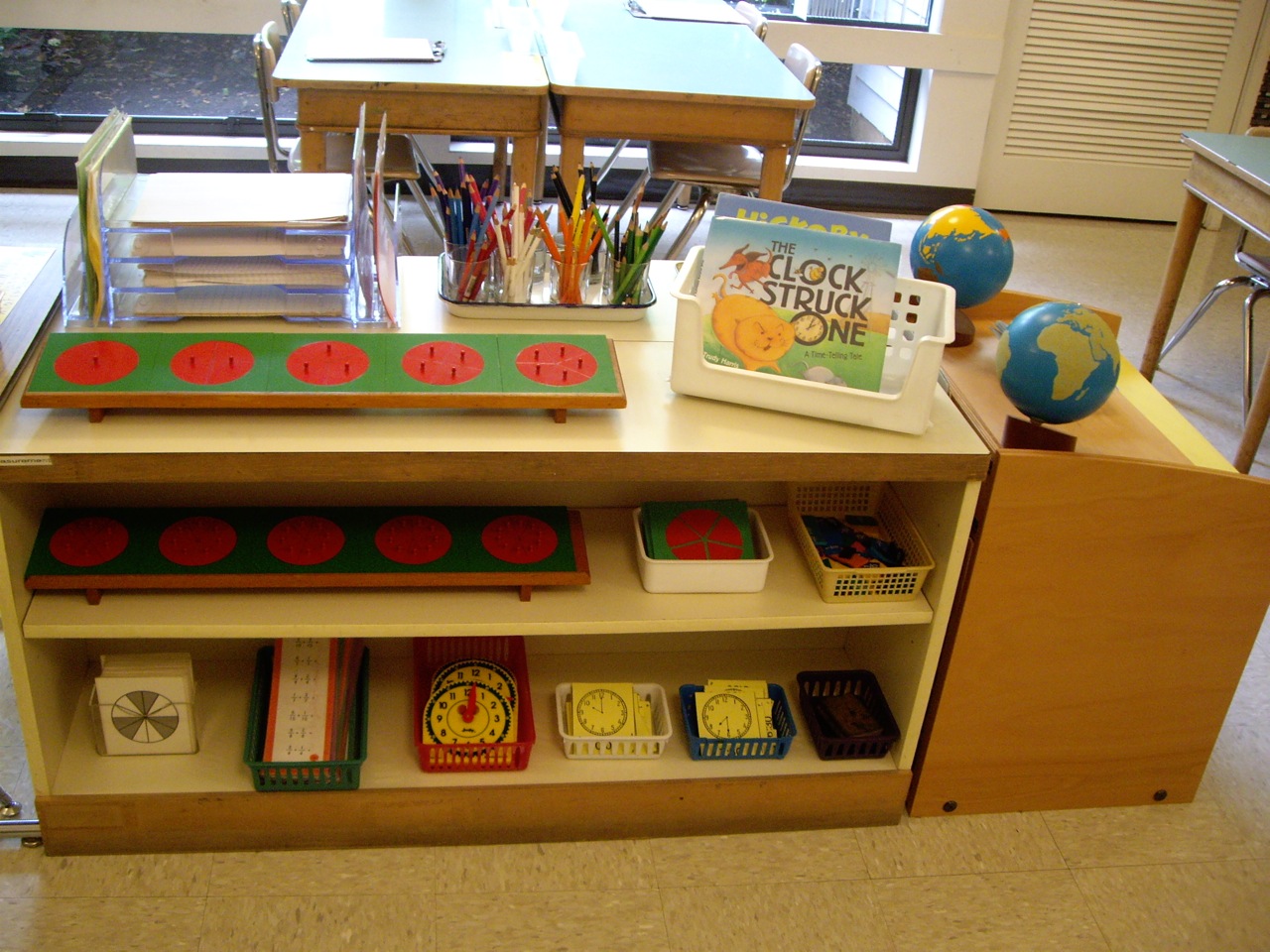
When visiting a Montessori classroom, visitors often notice respect for others, value for peace and concentration, attention to spatial awareness, and love for the environment. In Lower Elementary, we focus on the beginning of the second sequence of a child’s rebirth, what Montessori referred to as a “state of security and tranquility”, through the intellectual, emotional, social, physical, and spiritual life of the child.  As Montessori said, “The elementary child has reached a new level of development. Before he was interested in things: working with his hands, learning their names. Now he is interested mainly in the how and why…the problem of cause and effect.”  
Intellectually, the 6-9 child is curious, imaginative, interested in sharing ideas, and as Montessori put it, “hungry for culture”.  Montessori acknowledged the “importance of feeding the hungry intelligence and opening vast fields of knowledge to eager exploration”.  The center of the 6-9 curriculum, Cosmic Education, emerges in story form and through experiments, arriving at a time when the child craves reasons for things. The Great Lessons at the 6-9 level – the Coming of the Universe, the Earth, and Humankind – spark the imagination by giving a brief glimpse of the whole universe and its contents, thereby whetting the child’s intellectual appetite.  
Montessori believed that “the child’s mental powers are now such that they not only expand but soar, rising to new heights”.  The Cosmic Curriculum, which begins with grand concepts such as physics, chemistry, astronomy, geology, and geography and gradually zooms in on botany, zoology, and the human experience.  These areas of the curriculum are studied by all ages in varying levels of sophistication. Science experiments are integrated, as we discuss the Scientific Method. Students work with hands-on materials such as beakers and microscopes to investigate for themselves gravity, magnetism, volcanism, and states of matter. 
Maria Montessori wrote, in her book To Educate the Human Potential: “Since it has been … necessary to give so much to the child, let us give him a vision of the whole universe. The universe is an imposing reality, and an answer to all questions…. All things are part of the universe, and are connected with each other to form one whole unity. The idea helps the mind of the child to become focused, to stop wandering in an aimless quest for knowledge. He is satisfied having found the universal centre of himself with all things.” 
The Montessori classroom is organized both beautifully and sequentially, so that to the naked eye of child and parent, everything a child encounters seems do-able. Information is simplified and studies are approached in small steps, so that students can delve into material year after year and always learn something new. Montessori explained that the environment is prepared this meticulously so the child may be “left in peace to bring an activity to its logical and natural conclusion (and experience) a great sense of achievement”.  
Montessori education is sometimes accused of being either too structured, or not structured enough.  Though this may be a matter of opinion, the intention of the prepared environment and the responsible freedom encouraged of Montessori students is for the child to interact with materials in a hands-on fashion to the ultimate satisfaction of his/her passions. This is when true learning happens.  Students are most productive and engaged when a work is self-chosen, founded on individual interest with the teacher sowing a maximum number of seeds so that a few may find permanent root in your child’s heart and mind.  
Freedom of movement and freedom of choice are inherent to the child’s ownership of his/her learning process, and your child has the luxury of continuing with a work at his/her own pace, for as long as he/she benefits from the pleasure of repeating and encoding the purpose of that activity. That said, Montessori teachers are notorious observers and record-keepers, who follow a scope and sequence that spans nearly twenty subcategories within math, language, reading, and cultural studies. We track the learning of each child individually, present lessons to small or whole groups, and address the variety of learning styles present in the classroom, committed as we are to the Montessori mantra "follow the child".  
All Montessori materials, in addition to providing concrete experiences of abstract concepts, are sequential, developmentally-appropriate, self-correcting, and often made of wood, glass or metal.  The purpose of self-correcting material -- such as language cards which match images or objects with words and/or definitions -- is to encourage a child's self-esteem and self-reliance.  The materials are the teachers, as much as are the guides in each room.  Lessons introduce materials and activities, yet most of the time children work alone or in partner groupings (of their own choosing) so that work appears to be a game, as Montessori believed "work normalizes the child".
Maria Montessori said, “Education is a natural process carried out by the human individual, and is acquired not by listening to words, but by experiences in the environment.”  This belief is demonstrated well with the use of math materials such as the Golden Beads, the Stamp Game, the Bead Frames, the Checkerboard, and Rack and Tubes (also called the Test Tubes).  These materials help reinforce place value, so that the child learns in increments about concepts such as "exchanging" by first trading individual units for the next greatest place value, tens, and so on. Many of us who attended traditional schools marvel at what seems now an obvious visual and kinesthetic experience, since we often learned an abstraction or formula prior to (or in some cases, completely without) sorting, counting, or even touching quantities of things. 
Montessori teachers at the 6-9 level would implore parents to allow the teaching to happen at school with the materials rather than confuse the process by demonstrating "tricks" at home, since a child may resist using the myriad of hands-on materials if shown something deemed "easier", which is in fact much more complicated and introduced at the culmination of the learning cycle. Three years within the breadth and depth of the 6-9 classroom allows a child a never-ending supply of interests and exploration and demonstrates how a lifetime could be spent learning more about these endless questions. 

Sunday, May 6, 2012

Honoring the Spiritual Aspect of the 6-9 Child

Maria Montessori's most revolutionary act as a scientist and educator was her reverence for the child. Unlike other educational models, which consider children as a product of distributed information, Montessori education considers each student as an individual learner whose spirit is unique, whose time has value, and whose skills are informed by experience. Montessori education is special, because it allows the child to determine his/her learning from an abundance of experiences. Montessori described the spiritual aspect of a child as a “psychological attitude to himself and his life, within the environment, with others, how his personality is shaped by experience, and how experience leads to changes within himself.” Montessori schools honor the spiritual lives of children by giving them the world.
Spiritually, the 6-9 child is reflective and imaginative, experiences empathy and compassion, and is gradually becoming aware of the enormous world we live in.  Montessori noted, "All things are part of the universe and are connected with each other to form one whole unity. This idea helps the mind of the child to become fixed, to stop wandering in an aimless quest for knowledge." The Great Lessons begin from the largest concept and zoom in toward humankind, the world's youngest life form. As Montessori said, "work normalizes the child" through purposeful activity, in a calm atmosphere, within a prepared environment, and using hands-on materials. Care for the environment allows a child to make discoveries about the world, share thoughts and feelings with peers, and become a balanced, peaceful person. School is a place for learning not simply about the function of language and math operations, but about social conventions, communication, and caring for others in a community. Students love learning in a Montessori classroom, because it is a place that values their input.

One of the physical components of a Montessori classroom -- the prepared environment -- exists mainly to assist the spiritual life of the child. Montessori observed, "The more the capacity to concentrate is developed, the more often profound tranquility in work is achieved and the clearer will be the manifestation of discipline within the child." Materials are placed in an orderly and sequential manner on shelves within the child's reach so that he/she may freely select and manipulate works in zoology or geometry, word study or geography. The classroom is beautiful and simple, and the child works where he/she desires -- on a rug, at a table, in a rocking chair -- with ultimate control over a preferred mode of learning. The Montessori elementary classroom is rarely silent yet hums like a beehive, students respecting one another's work without disrupting the flow of a concentrating mind. 

The 6-9 child is growing increasingly independent, taking satisfaction in determining choices, and beginning to understand his/her place in the world. The child's soul has awoken to issues of justice, equality, and liberty. Matters of everyday life begin to resemble those of history and society, since the child sees the classroom as it is: a microcosm of the larger world. Learning experiences that encourage belonging and caring for the world reinforce a child's joy at the beauty of life. Montessori noted that, "If a person were to grow up with a healthy soul, enjoying the full development of a strong character and a clear intellect, they could not endure to uphold two kinds of justice—the one protecting life and the other destroying it. Nor would they consent to cultivate in their heart both love and hate." Montessori education seeks to give the child a sense of self-determination so that he/she may find peaceful solutions to conflicts. 

One of the core components of Montessori learning is going out, specifically into nature, to see the world both as a whole and in its parts. Montessori noted about the child that, "The things he sees are not just remembered; they form a part of his soul." The importance of children connecting their senses to the natural world cannot be overstated, especially when media has become an increasingly large part of family lives. Montessori children learn about the parts of a plant not simply through using wooden puzzles, tracing the segments, and labeling the names, but by going out into the habitat classroom, weeding in a garden, and walking to a nearby forest with his/her classmates. Recent scientific studies by the National Wildlife Federation suggest that going out into nature calms a child's stress level, increases fitness, reduces symptoms of ADHD, increases critical thinking skills, diminishes anxiety and depression due to over-structure and lack of free time, and enhances social interactions. The NWF also asserts that children now spend less than one hour per week in nature, as opposed to thirty hours per week indoors, sedentary, and viewing media. Montessori education allows for freedom of movement and incorporates nature in the daily classroom.

Traditional education pretends to know the capacity of children and constructs a system in which students perform in order to prove their merit. Maria Montessori declared that “education becomes a matter of helping the precious energies that manifest themselves with irrepressible force, for the soul is not a stone for sculpting according to the artist’s talent but is free energy whose expression and unfolding obeys its own inner laws”. Over a century ago, Montessori demanded that "education should no longer be mostly imparting of knowledge but must take a new path, seeking the release of human potentialities." Montessori education adapts to and honors all aspects of the child. Maria Montessori understood the spiritual life of the child, whom she described as "an enigma. There is in the soul of a child an impenetrable secret that is gradually revealed as it develops." The child is the keeper of the secret, and contact with the natural world gives the child a safe place to share that secret, thereby releasing the power of the child's energy into our collective future.