Showing posts with label movement. Show all posts

Sunday, May 6, 2012

More Free Play, Less Pressure, and Fewer Screens

Cosmologist Brian Swimme's latest book Journey of the Universe explains about young people, that “what often occupies their consciousness is play. They leap and twist; they explore the world with their eyes; they taste the world with their mouths; they enter into many kinds of relationships out of sheer curiosity. With their play, they are discovering the exuberance of being alive.” (p. 85) This observation resounded with me during parent-teacher conferences, when several parents said that their children experienced a positive change when their lives were less managed and they were allowed more free time to play.
Parents often express concern over such issues as their child's academic progress, time management, motivation, and social behavior. There is a fine line between adult guidance of a child and imposition of will upon him/her. Maria Montessori identified a teacher’s purpose: "to aid life, leaving it free, however, to unfold itself." Some parents ask what they should do at home to reinforce expectations at school, whether they should withhold extracurricular activities such as swimming or at-home play until their child performs the desired behavior. My consistent suggestion is to support the child wherever s/he is in his/her development and to avoid adding any pressure in the manner of rewards and punishments. It is relieving to hear so many parents validate how this approach of loving support benefits children's confidence, independence, and internal motivation. (PLAY Brown's TED talk on the subject below!)
In my daily interactions with students over the past decade, I have observed that children respond to respect, guidance, honesty, and flexibility. Montessori famously said, "The prize and punishments are incentives toward unnatural or forced effort, and therefore we certainly cannot speak of the natural development of the child in connection with them." Parents experiment with approaches, and some try to externally motivate their child with points, purchases, even food – soon discovering that their child no longer cares as much about what they are learning as with the carrot at the end of the parental stick. External motivation nearly always backfires, engendering resentment in the heart of the child, who understands very quickly that s/he isn’t trusted with his/her own education.

The crucial impact of play on the emotional, social, and cognitive development of children is described in the 2009 book Play: How It Shapes the Brain, Opens the Imagination, and Invigorates the Soul by Stuart Brown. A medical doctor, psychiatrist, and clinical researcher, Brown discusses how experts “from every point of the scientific compass now know that play is a profound biological process… It shapes the brain and makes animals smarter and more adaptable… it fosters empathy and makes possible complex social groups. For us, play lies at the core of creativity and innovation.” (p. 4-5) Despite this fact, children in many families learn -- from example -- that play is valued less than work and that work life blurs into private time without consideration for our emotional and spiritual needs.
Brown explains, “At some point, as we get older… we are made to feel guilty for playing. We are told that it is unproductive, a waste of time… The play that remains is, like league sports, mostly very organized, rigid, and competitive… The beneficial effects of… true play can spread through our lives, actually making us more productive and happier in everything we do.” (p. 6-7) Brown identifies seven properties of play: 
  • “apparently purposeless (done for its own sake),
  • voluntary,
  • inherent attraction,
  • freedom from time, 
  • diminished consciousness of self, 
  • improvisational potential, 
  • and continuation desire… 
We are fully in the moment, in the zone. We are experiencing what the psychologist Mihaly Csikszentmihaly calls ‘flow’.” (p. 17) It is this flow that parents hope their children will experience when they send them to Montessori school, yet this same priority must also be consistently maintained at home. (PLAY Csikszentmihaly's TED talk below!)

Brown cites renowned Washington State University play researcher Jaak Panksepp, who has found that “active play selectively stimulates brain-derived neurotrophic factor (which stimulates nerve growth) in the amygdala (where emotions get processed) and the dorsolateral prefrontal cortex (where executive decisions are processed).” (p. 33) Just as author Richard Louv coined the phrase “nature deficit” in children lacking contract with the outdoors, Brown notes a “ play deficit much like the well-documented sleep deficit”. (p. 43) He warns that "the threat to play is even greater than it was a generation or more ago… Kids today are spending too much of their time on video games… and the parentally organized, high expectation trip to the soccer field at age six… Schools have evolved into assembly lines for high test scores, where skills are drilled… Something is lost – perhaps unfettered imagination and freedom.” (p. 79) Free play is nearly extinct, except in half-hour allotments of recess.
Brown asserts that “movement structures our knowledge of the world, space, time, and our relationship to others… Movement play lights up the brain and fosters learning, innovation, flexibility, adaptability, and resilience... which are required for the emergence of fluent human language.” Especially relevant to Montessori classrooms, Brown describes how “object play with the hands creates a brain that is better suited for understanding and solving problems of all sorts.” Imaginative play “remains the key to emotional resilience and creativity… developing empathy, understanding, and trust of others, as well as personal coping skills.” (p. 84-87) For many students, their school day begins at seven in the morning and ends at six in the evening with after-school care. Many have multiple evening and weekend "enrichment" activities, with very little free play time for themselves. As I have seen on many occasions that children seem afraid of nature and don't know how to enter it nor enjoy its wonder.
“We may think we are helping to prepare our kids for the future when we organize all their time, when we continually ferry them from one adult-organized, adult-regulated activity to another," Brown suggests. "In fact, we may be taking from them the time they need to discover for themselves their most vital talents and knowledge… access to an inner motivation for an activity that will later blossom into a motive force of life.” Not long ago, Brown reminds us, “self-organized play was all kids did” and warns that if children are deprived of free play, “they will find their own new ways of asserting their own community, socialization patterns, and individuality… creating their own private play zone where they … socialize freely.” (p. 105-108). Brown points to the advent of texting, juvenile cell phone use, and online communities as examples of the new locations of children's privacy, in the absence of a back wood. Children are often left to their own devices, literally: an iPad, Wii, or YouTube. 

Screen play concerns Brown because it can “isolate people from real-world, human interactions that are an essential part of psychological health… The storyline is set by the box, and the kids are now merely along for the ride, motionless and mute… In the real world, the kind of emotional arousal that these screens and games produce is discharged through physical activity” without which “kids can become antsy and unfocused”. Screen play neglects “a deep human need to interact with the material world: to feel the tug of gravity, to physically move through the dimensions of space and time, to feel the physical resistance of solid objects.” Applicable to Montessori classrooms, Brown notes that “the use of the hands to manipulate three-dimensional objects is an essential part of brain development.” (p. 183-185) From a century ago, Montessori echoes Brown: "Movement, or physical activity, is thus an essential factor in intellectual growth, which depends upon the impressions received from outside. Through movement we come in contact with external reality, and it is through these contacts that we eventually acquire abstract ideas."


Montessori's observation -- that “work normalizes the child” – is also Brown’s advice: “The quality that work and play have in common is creativity. In both we are building our world, creating new relationships… Play is called recreation because it makes us new again.” It is “nature’s greatest tool for creating new neural networks and for reconciling cognitive difficulties.” (p. 127-128) So many Montessori materials appear to children as learning games: the stamp game, the checkerboard, the test tubes. Montessori students view education as play, because materials are ordered, thoughtful, beautiful, tactile, and fun!

Still, parents worry that their child may somehow fall behind others. Many parents show interest in test scores and would like to know where their child places amongst his/her peers. Quantitative, competitive measures are incompatible with the Montessori philosophy that each child grows at his/her own rate, learns by using  concrete materials, and values emotional and spiritual development as much as intellectual or social behavior. The latter two are easily determined, while the former involve understanding of and compassion for a child's uniqueness. Montessori believed that "when dealing with children, there is greater need for observing than of probing." 
No child will be left behind when each child is respected. Brown reminds us that “people reach the highest levels of a discipline because they are driven by love, by fun, by play.” (p. 143) Chore charts and stars have no place in a respectful relationship between child and adult. Brown adds, “The acquisition of good grades or a big bonus, if not connected to the heart of life, is dispiriting, even if accolades accrue.” (p. 145) Seeking parental approval is on par with fear of parent disappointment. I am so proud to work at a school that provides open, proactive communication with parents, as well as vivid, qualitative narratives to describe a child better than any number or letter. 

Brown's advice to parents is succinct: more free play, less pressure, fewer screens. “Nature, with all its novelties and the play emotions stirred by its wonders, gets through to kids if the immersion can be tailored to fit their temperament and natural curiosity.” (p. 204) Parents are amazed to see their child's temperament, interests, self-esteem, and joy after an hour of free time in an open field. Children have the rest of their lives to live like adults; they only have one childhood. Let them go outside!

Honoring the Spiritual Aspect of the 6-9 Child

Maria Montessori's most revolutionary act as a scientist and educator was her reverence for the child. Unlike other educational models, which consider children as a product of distributed information, Montessori education considers each student as an individual learner whose spirit is unique, whose time has value, and whose skills are informed by experience. Montessori education is special, because it allows the child to determine his/her learning from an abundance of experiences. Montessori described the spiritual aspect of a child as a “psychological attitude to himself and his life, within the environment, with others, how his personality is shaped by experience, and how experience leads to changes within himself.” Montessori schools honor the spiritual lives of children by giving them the world.
Spiritually, the 6-9 child is reflective and imaginative, experiences empathy and compassion, and is gradually becoming aware of the enormous world we live in.  Montessori noted, "All things are part of the universe and are connected with each other to form one whole unity. This idea helps the mind of the child to become fixed, to stop wandering in an aimless quest for knowledge." The Great Lessons begin from the largest concept and zoom in toward humankind, the world's youngest life form. As Montessori said, "work normalizes the child" through purposeful activity, in a calm atmosphere, within a prepared environment, and using hands-on materials. Care for the environment allows a child to make discoveries about the world, share thoughts and feelings with peers, and become a balanced, peaceful person. School is a place for learning not simply about the function of language and math operations, but about social conventions, communication, and caring for others in a community. Students love learning in a Montessori classroom, because it is a place that values their input.

One of the physical components of a Montessori classroom -- the prepared environment -- exists mainly to assist the spiritual life of the child. Montessori observed, "The more the capacity to concentrate is developed, the more often profound tranquility in work is achieved and the clearer will be the manifestation of discipline within the child." Materials are placed in an orderly and sequential manner on shelves within the child's reach so that he/she may freely select and manipulate works in zoology or geometry, word study or geography. The classroom is beautiful and simple, and the child works where he/she desires -- on a rug, at a table, in a rocking chair -- with ultimate control over a preferred mode of learning. The Montessori elementary classroom is rarely silent yet hums like a beehive, students respecting one another's work without disrupting the flow of a concentrating mind. 

The 6-9 child is growing increasingly independent, taking satisfaction in determining choices, and beginning to understand his/her place in the world. The child's soul has awoken to issues of justice, equality, and liberty. Matters of everyday life begin to resemble those of history and society, since the child sees the classroom as it is: a microcosm of the larger world. Learning experiences that encourage belonging and caring for the world reinforce a child's joy at the beauty of life. Montessori noted that, "If a person were to grow up with a healthy soul, enjoying the full development of a strong character and a clear intellect, they could not endure to uphold two kinds of justice—the one protecting life and the other destroying it. Nor would they consent to cultivate in their heart both love and hate." Montessori education seeks to give the child a sense of self-determination so that he/she may find peaceful solutions to conflicts. 

One of the core components of Montessori learning is going out, specifically into nature, to see the world both as a whole and in its parts. Montessori noted about the child that, "The things he sees are not just remembered; they form a part of his soul." The importance of children connecting their senses to the natural world cannot be overstated, especially when media has become an increasingly large part of family lives. Montessori children learn about the parts of a plant not simply through using wooden puzzles, tracing the segments, and labeling the names, but by going out into the habitat classroom, weeding in a garden, and walking to a nearby forest with his/her classmates. Recent scientific studies by the National Wildlife Federation suggest that going out into nature calms a child's stress level, increases fitness, reduces symptoms of ADHD, increases critical thinking skills, diminishes anxiety and depression due to over-structure and lack of free time, and enhances social interactions. The NWF also asserts that children now spend less than one hour per week in nature, as opposed to thirty hours per week indoors, sedentary, and viewing media. Montessori education allows for freedom of movement and incorporates nature in the daily classroom.

Traditional education pretends to know the capacity of children and constructs a system in which students perform in order to prove their merit. Maria Montessori declared that “education becomes a matter of helping the precious energies that manifest themselves with irrepressible force, for the soul is not a stone for sculpting according to the artist’s talent but is free energy whose expression and unfolding obeys its own inner laws”. Over a century ago, Montessori demanded that "education should no longer be mostly imparting of knowledge but must take a new path, seeking the release of human potentialities." Montessori education adapts to and honors all aspects of the child. Maria Montessori understood the spiritual life of the child, whom she described as "an enigma. There is in the soul of a child an impenetrable secret that is gradually revealed as it develops." The child is the keeper of the secret, and contact with the natural world gives the child a safe place to share that secret, thereby releasing the power of the child's energy into our collective future.

Honoring the Physical Aspect of the 6-9 Child

Most forms of education focus primarily on the intellectual, but education is not limited to math, language, and cultural studies. It also encompasses an education of the senses, which in Montessori education includes art, fine motor (such as pouring, drawing, and writing), and gross motor development. Physical education evolves through freedom of movement, exploration of nature, fitness, and hand-eye coordination. As Montessori said, “Since it is through movement that the will realizes itself, we should assist a child in his attempts to put his will into action.”
Physically, the 6-9 child has longer limbs and strong muscles, is more resistant to disease, and shows a fascination with anatomy and all kinds of bodily functions, noises, and/or scatological jokes.  The Montessori environment appears most different from traditional educational settings in its physical dimension. Visitors notice that students move freely, often engaging in individual or partner work, rather than all students facing a teacher. 
Maria Montessori, a scientist trained in observation, revolutionized educational practices in the early 20th century when she announced, "free choice is one of the highest of all the mental processes." She quickly clarified in her involvement with street children of Rome, Italy, "To give a child liberty is not to abandon him to himself… To let the child do as he likes when he has not yet developed any powers of control is to betray the idea of freedom…The essence of independence is to be able to do something for one’s self." Freedom within limits, choice within order, and exploration within sequence are core to the Montessori method, yet above all exists respect for the child.

Prior to Montessori, education in America was heavily influenced by John Dewey, who modeled learning after industrial mass production.  Sadly, even now in the early 21st century, public education is dominated by a business model that treats children like products. Maria Montessori was ahead of her time in valuing the child as a source of inspiration, not simply a by-product of testing.  Montessori observed a child's need for physical contact with materials in exploration. As Montessori said so eloquently, "If teaching is to be effective with young children, it must assist ... independence… activities which they can perform themselves ... Any child who is self-sufficient... reflects in his joy and sense of achievement the image of human dignity, which is derived from a sense of independence.
The 6-9 child has an enhanced sense of personal space and spatial relationships. Montessori classrooms are tailored to the physical development of the child.  Shelves, desks, and materials are at a child’s level, and freedom of movement is incorporated to refine gross and fine motor skills and respect the child’s desire to have physical control over objects.  Materials are sequential, organized, attractive, and accessible to the child. One of the main tenets of Montessori education is the prepared environment and teacher as guide. As Maria Montessori said, "The environment must ... lend interest to activity and invite the child to conduct his own experiences...Education is a natural process carried out by the human individual and is acquired not by listening to words, but by experiences in the environment."  

Montessori also said, "No social problem is as universal as the oppression of the child." What other education reformer has ever been so on the side of the child as Maria Montessori? She pre-saged our modern predicament where the activity level of children becomes an issue of control for adults. In Montessori classrooms, the power center of the adult is transformed to the individual and the community, each respecting one another through the physical realm. Montessori education values, among other things, the physical life of the child. In traditional classrooms, children are confined to chairs and desks to engage in simultaneous activities under the supervision of a teacher. In a Montessori classroom, as Montessori herself described, “the environment itself will teach the child, if every error he makes is manifest to him, without the intervention of a parent or teacher, who should remain a quiet observer of all that happens.” 

How is this possible? As a scientist, Montessori followed the scientific method of observation, hypothesis, and experiment. Her values were the same as those of current Montessorians: environment, independence, and experience. They work together in many capacities, for example: at PE, lifting a parachute together.
The prepared environment allows students optimum freedom of movement through sequential organization of materials which are self-correcting, enhancing the child's independence. In addition, students frequently arrange materials at rugs on the floor. At Eton, on one of the first days of school, students attend a rules assembly that illuminates ways in which the physical aspect of the child is honored: interdependence of mind and body, respect and care for the body, refining and strengthening physical skills, and purposeful movement. As Montessori said, “Seemingly simple acts of unrolling a rug, carrying a work on a tray, keeping all material within a space, and replacing items at the end of a work are practices not only in diligence but in coordination and concentration… We must, therefore, quit our roles as jailers and instead take care to prepare an environment in which we do as little as possible to exhaust the child with our surveillance and instruction.”

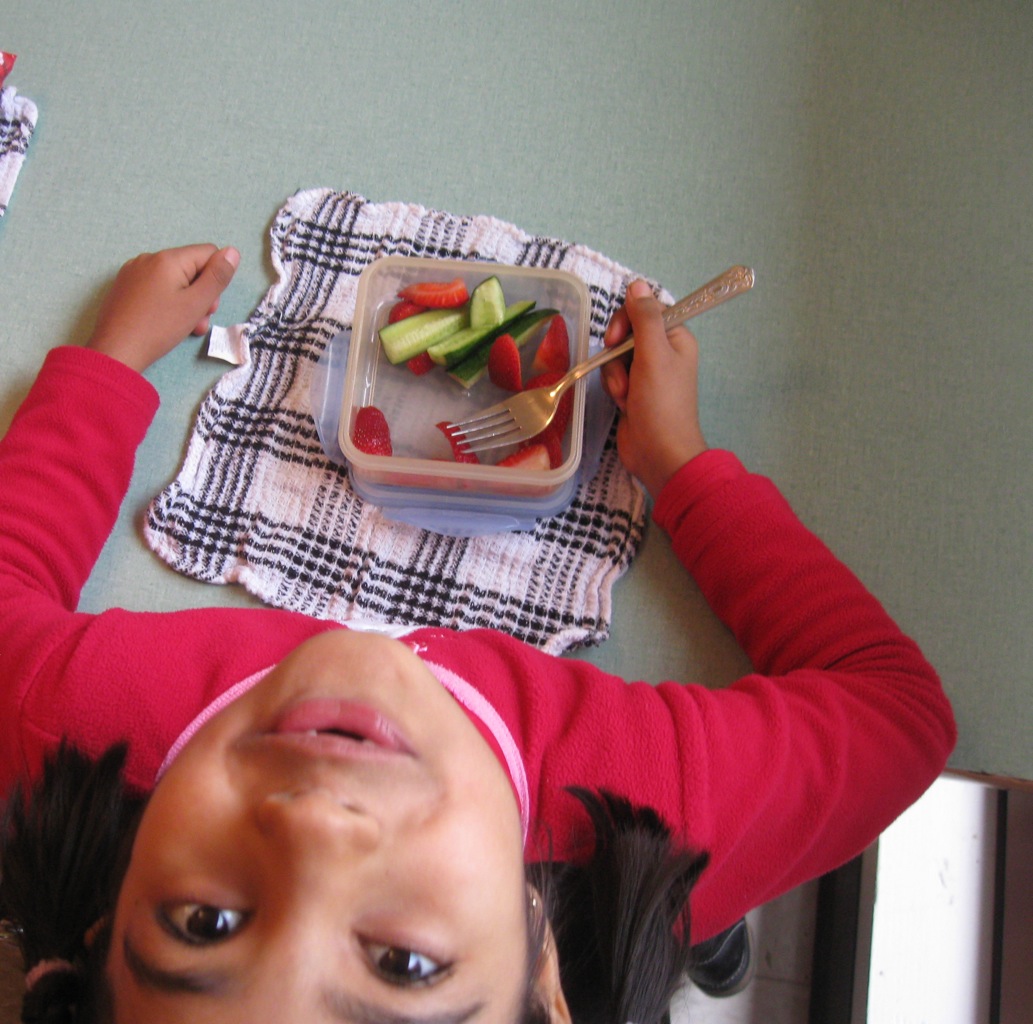
Independence is key to the 6-9 child’s development, however independence does not mean unlimited freedom. Lower elementary students use work plans in addition to sequential materials, in order to hone time management skills. They are in charge of their learning, what Montessori called “auto-education”: “The child, in fact, once he feels sure of himself, will no longer seek the approval of authority after every step.” Many materials (such as rugs, scales, and pattern blocks) encourage fine and gross motor development. Students learn to listen to their bodies and have snack when their bodies require it. Children no longer ask, “May I have snack?”  They have placemats and know how to wash their hands.
Working, interacting, and eating are personal experiences. A prepared environment is scaffolding for self-determination learned through independence and strengthened through experience. Maria Montessori understood over a century ago that “growth comes from activity, not from intellectual understanding.” Montessori education is not memorized knowledge but respect for all aspects of a person: intellectual, emotional, social, spiritual, and physical.  Montessori charged us to “respect all the reasonable forms of activity in which the child engages and try to understand them… Watching a child makes it obvious that the development of his mind comes through his movement.”

Current educational and scientific research corroborates Maria Montessori’s hundred-year-old vision, as author Richard Louv explains in his book Last Child in the Woods: Saving Our Children from Nature-Deficit Disorder. Louv notices that “within the space of a few decades, the way children understand and experience nature has changed radically…Today, kids are aware of the global threats to the environment—but their physical contact, their intimacy with nature, is fading.” Louv connects avoidance of direct experience in nature with a societal sense of doom for forests and deserts, oceans and lakes which previously evoked joy and solitude. Students plant herbs and weed in gardens, have lessons in the outdoor habitat, and run free at recess and during PE under evergreen trees that reach a hundred feet in the air. 
Without this daily contact with the natural environment, Louv warns, “the young spend less and less of their lives in natural surroundings, their senses narrow, physiologically and psychologically, and this reduces the richness of human experience.” Louv calls this modern phenomenon “nature deficit disorder,” a term seemingly in-line with common diagnoses for those whose energies would benefit from both freedom and structure. Louv reminds us, “Thoughtful exposure of youngsters to nature can even be a powerful form of therapy for attention-deficit disorders and other maladies. As one scientist puts it, we can now assume that just as children need good nutrition and adequate sleep, they may very well need contact with nature.”